

Psalm 20:2

_

“The Lord gives me light and saves me. O whom shall I be afraid?”

_

People who live in the countries with the most formidable armaments, the greatest economic power and the most advanced social and medical developments are supposed to be the most secure. The latin word ‘securitas’, from which our word ‘security’ derives, actually suggests a condition of being free from care. How about you? Are you secure, free from care? Probably not. 

No matter how hard we try, life simply does not result in being free from care. This is especially true in a society that bases security on externals, on possessions, money, power, appearance, and so forth. Searching for freedom from care among these things is tantamount to “looking for love in all the wrong places.” Search all you want in these places, you wont find freedom from the cares of life. What you will find is a constant diet of gnawing fear, tension and insecurity. 

Jesus spoke of living in the opposite direction. Instead of becoming a sad cliche’ and grasping at all the usual securities, Jesus said that the key to finding life is to lose it. Or, we might say, let go of it. The search for security is, in the end, an expression of fear that drives us back into ourselves, into all sorts of silly efforts at self-preservation. The life of faith is lived outward and is expressed in a bold, joyful daring.

No one who has stood at the foot of the cross and beheld the dying form of our Lord Jesus ever need fear again. This does not to say that a living faith in Jesus Christ is not utterly beset by conflicts, struggles and troubles. At the same time this faith is utterly secure. For the freedom of Christian faith has no need to expect or desire anything beyond that which comes from God’s gracious, caring hand.


“May the peace of God that passes all understanding keep your hearts and minds in Christ Jesus our Lord.”


_

Revelation 19:7-8

_

“Let us rejoice and be glad and give him glory!

For the wedding of the Lamb has come,

 and his bride has made herself ready.”

_

There is something about the Christian life that is similar to engagement. It is tentative. Or, we could say, incomplete, even unsatisfactory. I have sat with engaged couples over the years who had begun to question their intention to marry. They were usually dismayed at this but my counsel to them was that this is what engagement periods are for. An engagement period is supposed to be a time of searching and testing, a step toward the public promises of marriage. It is not the time of fulfillment and it may be the time that leads to the decision to go separate ways.

The important thing in this period of their life is that they learn to be faithful to one another. The time of engagement is the time of learning to trust. There is hope and love, too. But it is not until marriage that they discover the “greatest of these is love.”

So now in this life we live in faith and hope. Our love is immature. But when Christ Jesus comes again, when the Bridegroom comes to claim His bride, we will experience the full depth of His perfect love and realize why our faith and hope were not in vain. Christ’s presence will be overwhelming, His purpose so obvious, His love so completely satisfying, that all doubts will be stilled and all longings fulfilled.


“May the peace of God that passes all understanding keep your hearts and minds in Christ Jesus our Lord.”

_
Hebrews 13:5

_

“I will never leave you or forsake you.”

_

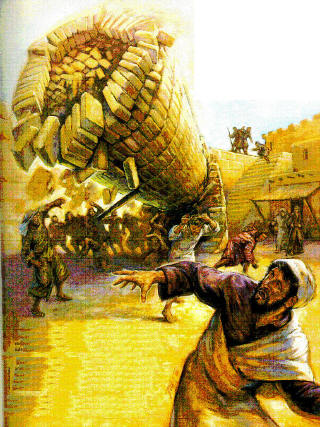
In the southern district of ancient Jerusalem stood the tower of Siloam. At some point during the ministry of Jesus the tower collapsed killing eighteen people. The Lord asked His disciples, “Do you think they were worse offenders than all the others who live in Jerusalem? No, I tell you…”

Pain and suffering are realities that we must deal with one way or another. We may attempt to discover a cause, and that can be good. Pain can be our salvation, for example, when we realize that some changes must be made. Children learn not to touch a shot stove. An accident may teach us to drive more carefully. The lessons to be learned through many types of suffering may be quite simple: Humans are mortal and safety pays.

We may also look for answers where there are none. Our determination to find answers may result in us coming up with the wrong ones. We may look at ourselves and ask, “What have I done that God should punish me like this?” Or, we may blame others, even God, and say, “Why me? I’ve been a good person. I don’t deserve this. God isn’t fair.”

If there are no obvious answers to pain and suffering it may be more beneficial to accept our suffering as something that is common to many and understand that nothing terribly unusual has happened to us. We have a lot of fellow sufferers. Instead of groping for answers or blaming how about sharing our distress with others? Many around us would appreciate the opportunity to offer support and comfort. And we may do the same for others so they know they are not alone.

God has promised that one day we will enter the perfect joy of His eternal kingdom where pain and suffering will be no more. Until then, our loving and merciful God who in Christ Jesus experienced torn flesh, burning thorns, utter loneliness and rejection has given us His this assurance; “I will never leave you of forsake you.”  Sometimes, perhaps most of the time, it is not answers we need but the comfort and assurance of His presence.


“May the peace of God that passes all understanding keep your hearts and minds in Christ Jesus our Lord.”


_

Luke 7:49

“Who is this that forgives sins?”

_

If a best friend lets you down, betrays your trust, your relationship is of a different character than it was before. Probably all of us at one time or another have been on one side of these dynamics or the other. Humanly speaking we do not seem to have the emotional equipment to deal with faithlessness.

Now let’s invite Jesus into the picture. He not only dealt with faithless people, but He also talks about forgiveness in a different way than anybody else. The people of His day were amazed at things He said, and they asked, “Who is this that forgives sins?”

Jesus not only forgave sins that were considered unforgivable in those days, but He also forgave His best friends when they proved faithless to Him.  They had glorious opportunities to stand up and be counted as His friends. But they let Him down.

There is an old legend that tells of Jesus meeting Satan out in the desert just prior to His Ascension into heaven. Satan mocked the Lord for being so foolish as to think that His faithless followers would ever make it without His visible presence among them.  The Lord replied that His disciples would trust Him and go out into the world in His name. But Satan just laughed.

As it turned out, every one of His disciples, after Judas, was faithful unto death. They were faithful because their Lord forgave their faithlessness and remembered their sins no more.

The disciples went on to do glorious things in Christ’s name. Do you think of yourself as too ordinary, too faithless to be of much good for Christ?  Your lack of faith is not the story. He is always faithful. He not only forgives your sins, He forgets them. Don’t be surprised if you find yourself with glorious opportunities to serve Him. In baptism He has chosen you. The promise of His forgiveness makes all things new. There is nothing ordinary about you, for you have an extraordinary Lord!


“May the peace of God that passes all understanding keep your hearts and minds in Christ Jesus our Lord.”


_

Acts 1:6

_

“Lord, will you at this time restore the kingdom to David?” 

_

The Lord’s disciples wondered aloud if He had come to restore the kingdom of David. Jesus was dismayed and said, “Have I been with you so long and you still don’t understand?” The mother of James and John asked the Lord that her two boys might have positions of honor and authority in His new kingdom. She envisioned them sitting on either side of the Lord’s throne. Jesus retorted that she had no idea what she was asking. Pontius Pilate asked if Jesus was a king. He replied, yes, except His kingdom was not of this world.  On the day of the Ascension, as Jesus was taken up to heaven, the disciples were still asking, “Lord, will you at this time restore the kingdom to David?” They just didn’t get it.

Political passions are running high these days. What else is new. The push and pull of politics is as old as dirt – and at times worth about as much.  It isn’t that we can dispense with politics, with earthly governance. All forms of governance are expressions of law. Some forms are better than others, but all have their temporary place in the management of human affairs. Power is at stake, of course. And wherever power is at stake, expect it to bring out the worst in people. Politics has a way of doing that. Look again at the disciples. My suspicion is that all this high-minded talk about the kingdom of David had something to do with political payback, gaining the high ground, sticking it to the Romans. The blatant political self-interest of the mother of James and John was so embarrassingly obvious, Jesus waived it aside with a word.

The Lord had His opportunity, when he stood before the Roman governor, to lay out His politics, His platform, His agenda. The political sensibilities of a Roman politician like Pontius Pilate were tuned to a high pitch. If he had sensed the remotest threat in Jesus it would have been enough to remove Him. But after examining Jesus, a relieved Pilate said, “I find no fault (read, threat) in Him.” He seemed to grasp what the disciples could not. 

Jesus did not come to establish an earthly kingdom. You’d never know it, however, when you listen to many Christian voices – on the left and right – who claim to speak for God. Your voice might be in this chorus. While we wait for the new heaven and the new earth we must still live here. But this transitory life, so full of difficulty and conflict, can cause the Christian to lose sight of the goal and we can go astray and be consumed by the passions of politics. So we need to hear again how Jesus responded to these misplaced passions among His own. For that is the caveat.

Do you, Christian, have more passion for the lords of this world than the Lord of the Church? 


“May the peace of God keep your hearts and minds in Christ Jesus our Lord.”


_

Matthew 13:44

 _

“The kingdom of heaven is like a treasure hidden in the field, which a man found and hid again; and from joy over it he goes and sells all that he has and buys that field.”

_

In His book, Bible Windows, author Ivar Powell tells the story of a rich man who died and left no heirs and, apparently, no will. When his household goods were auctioned, the bidding was fast and furious until a small painting of the dead man’s son was brought forward. The painting had been cherished by the wealthy father because the boy died at an early age.The auctioneer did his best but the crowd showed no interest. Finally, a frail, elderly woman in drab garments placed a small bid and the painting was hers. She had been the boy’s nurse when he was a baby and had loved him dearly. Later, as she examined the painting closely, she noticed a bulge in the backing. Making a small cut, she removed an envelope which turned out to be the man’s missing will. The document stated very clearly that he wanted to leave his entire fortune to the person who still held dear the memory of his beloved son.

There are many facets of church life that draw our attention. Those who desire structure may be drawn to its’ institutional aspects. Others with an aesthetic interest may be drawn to its’ rich musical and artistic heritage. Still others see value in the church’s social concern, youth programs or congenial fellowship. The “bidding wars” over these matters in church life can be fierce. But they are penultimate matters at best.  Preoccupation with them can blind us to the great center of church’s life.

The priceless treasure of the Church is Jesus Christ. In Him God has revealed His will and grace, His determination to forgive sins. In a real sense, if we have all the things mentioned above but do not have Christ, we have nothing of any lasting value. If we have Him, though we are poor in every other way, we can say with joy and gratitude that we are rich. 


“May the peace of God that passes all understaning keep your hearts and minds in Christ Jesus our Lord.”


_

Romans 13:10

_

“Love does no wrong to a neighbor; therefore love is the fulfillment of the law.”

_

The first major storm of the hurricane season recently came on shore near New Orleans. Unwelcome flood waters drove many from their homes. News reporters stood in the withering downpours, like battlefield journalists, giving blow by blow descriptions of the storm and its’ progress. They brought us live pictures of driving rain, devastaing winds and the valiant efforts of people as they struggled to stand against  the onslaught.

We are also in another storm of sorts. It is has far more power than many hurricanes, inflicts untold amounts of damage and roars through the world virtually unchecked. That storm is the willfulness and assertion of the unrestrained self.

This is no more apparent than in contemporary efforts to redefine marriage to include same sex unions. Advocates of this particular expression of willfulness are storming across the landscape, putting the culture on the defensive. Like all storms, the effects of this movement are not to build up but to destroy. The millions of selves that are wittingly or unwittingly engaged in this effort are well on their way. And this is but one issue among many.

Self-indulgence and unfettered self-expression have become politically correct, even ‘chic’. But this storm of self-expression is wreaking havoc on our society. Hedonism is no joke.

Christian people are called to stand against the maelstrom of human willfulness. And this begins with the self.  At times, this requires from me a return to the diminutive, to repentance. It may also require me to support  the application of human law in defense of society and its’ interests.

At all times the Christian is called to stand against the chaotic forces within life with the law of love. This is the God-given place of tranquility within the eye of the storm. This law is always defining for us and seeks to do no harm to the self or the neighbor. As St. Paul has reminded us,


Love is patient and kind; love does not envy or boast; it is not arrogant or rude. It does not insist on its own way; it is not irritable or resentful;it does not rejoice at wrongdoing, but rejoices with the truth. Love bears all things, believes all things, hopes all things, endures all things.”


“May the peace of God that passes all understanding keep your hearts and minds in Christ Jesus our Lord.”


_

Ephesians 10:9

 _

“I am the gate; if anyone enters by me he will be saved and will go in and out and find pasture.”

_

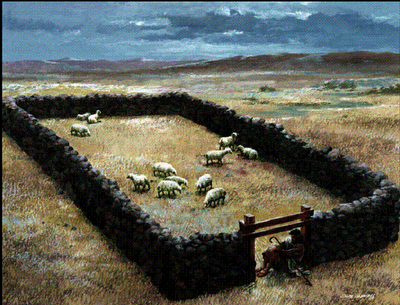
Ancient sheep pens had only one gate. Sheep entered or left the pen by that gate or not at all. At night, when the sheep were gathered within the enclosure, the shepherd actually slept in the opening. He was there to keep the sheep from wandering off and to protect them from predators.

The writer of the Letter to the Ephesians gives us some perspective on the one Gate who is Christ, the Word of God. “There is one body and one Spirit, just as you were called to the one hope that belongs to your call, one Lord, one faith, one baptism.” (Ephesians 4:4-5)

The image of Jesus Christ as the Gate, the place of access, is focused, narrow and exclusive. It is meant to be. For it is only in the Word and promise of God by which the Holy Spirit unites us with the One Lord, into the One Faith, through the One Baptism. God in His gracious love not only tells us in His Word about what he has done for our salvation, but in the One Baptism He places the seal of promise upon our heads. In baptism God, the Gate, opens the way, becomes the Way. In the One baptism God says, ‘Everything my Son has done is for you, not just for the world in general.’ In the One Baptism God makes the promise specific to you.

There is nothing flattering about Christ referring to us as sheep. It is an image of a creature who becomes easily lost, is vulnerable to predators and cannot look out for its’ own welfare. But because we are blessed to have a Good Shepherd, One who loves us and and has given His life for us, we may enter the dicey business of living with confidence and assurance.

He who has called you by name in your baptism and watches your going out and your coming in has opened your future. You can trust Him.  For even this day He is leading you into the safety, abundance and freedom of His kingdom.


“May the peace of God that passes all understanding keep your hearts and minds in Christ Jesus our Lord.”


_
Matthew 6

_

“Our Father…”

_

Just looking at outward behavior (allowing for those who perhaps offer up a silent prayer of gratitude) it would appear that there are lots of critters nosing up to the troughs at those high-class barnyards we call restaurants, mindful of little else beside their appetites.

When my kids were small I used to say them, “Only the animals don’t pray before they eat.”  This was not meant to reflect badly on pigs or chickens. They follow unerring instincts and appetites. When pigs scramble for the slop you will hear no grunts of gratitude. No higher dimension of life is required of them. The same cannot be said for you or me. We give ourselves away at the table when the gifts there are not recognized as such and the Giver is not acknowledged.

Even a cursory reading of the gospels reveals that our Lord Jesus Christ lived in an attitude of prayer. He prayed habitually, regularly seeking out times and places to talk with the Father. Prayer was, and is, a dimension of what it means to be truly human. In this respect prayer is not something we do as simply an aid to faith nor is it an exercise in manipulating God in our direction. Prayer is a symptom of a living relationship. We pray because we are aware that we are being heard.

When Jesus taught His disciples to pray (and it is instructive that they had to be taught) He taught them to address God as Father. It is not how we pray that is significant but to whom we pray. When we call God “Our father…” we dare to trust Him as provider, defender, One with whom we walk hand in hand, life in life. 

So, the next time you are at the feed trough, before you and your appetite dive in, remember, prayer is something you do because you are somebody – you are the child of a loving Father “from whom all blessings flow.”


“May the peace of God that passes all understanding keep your hearts and minds in Christ Jesus our Lord.”


_

Ephesians 2:8

_

“For by grace you have been saved through faith. And this is not your own doing; it is the gift of God,”

_

Martin Luther’s attack on free will, where salvation is concerned, has dismayed Lutherans and enfuriated critics ever since. The cry continually goes up, “We have to do something, don’t we?” Luther might respond like this; ‘And just what are you planning on doing? is there something regarding your salvation that Christ has not done for you?’

 Here, in his own words, Martin lays the axe to our free-will pretensions.

 “For my own part, I frankly confess that even if it were possible, I should not wish to have free choice given to me, or to have anything left in my own hands by which I might strive toward salvation. For, on the one hand, I should be unable to stand firm and keep hold of it amid so many adversities and perils and so many assaults of demons, seeing that even one demon is mightier than all men, and no man at all could be saved; and on the other hand, even if there were no perils or adversities or demons, I should nevertheless have to labor under perpetual uncertainty and to fight as one beating the air [1 Cor 9.26], since even if I lived and worked to eternity, my conscience would never be assured and certain how much it ought to do to satisfy God.

For whatever work might be accomplished, there would always remain an anxious doubt whether it pleased God or whether he required something more, as the experience of all self-justifiers proves, and as I myself learned to my bitter cost through so many years. But now, since God has taken my salvation out of my hands into his, making it depend on his choice and not mine, and has promised to save me, not by my own work or exertion but by his grace and mercy, I am assured and certain both that he is faithful and will not lie to me, and also that he is too great and powerful for any demons or any adversities to be able to break him or to snatch me from him. “No one,” he says, “shall snatch them out of my hand, because my Father who has given them to me is greater than all” [John 10:28 f.]. 

So it comes about that, if not all, some and indeed many are saved, whereas by the power of free choice none at all would be saved, but all would perish together. Moreover, we are also certain and sure that we please God, not by the merit of our own working, but by the favor of his mercy promised to us, and that if we do less than we should or do it badly, he does not hold this against us, but in a fatherly way pardons and corrects us.” (Luther’s Works, vol. 33, pgs. 288-289“.   

TIMBER!

_

“May the peace of God that passes all understanding, keep your hearts and minds in Christ Jesus our Lord.”


_