

Romans 3:23

rbby_92

_

 “For all have sinned, and fallen short…”

_

We’re all familiar with Murphy’s Law; ‘If something can go wrong it will go wrong.’ Or, there are those famous commentaries on Murphy’s law; ‘Murphy was an optimist’ and, ‘If you think things are getting better, look again!’ 

We can chuckle over such unvarnished pessimism but it has a very long history and is well-entrenched in our Lutheran heritage.

Traditional Lutheran language about sin has emphasized the totality of our sinfulness.  The older service of confession and forgiveness spoke of our being ‘sinful and unclean’. Nowadays, we use the language of being in ‘bondage to sin’. In either case the Lutheran tradition has wanted to take sin seriously. But this emphasis on the total sinfulness of humanity also has caused problems. Many of us remember a Lutheran church that constantly reinforced the sinfulness of people to the point where there was simply no point in looking for anything good. This in-house pessimism created a Lutheran culture of quietism and cynicism. The human future was bleak. What was actually a very important biblical and theological emphasis became quite destructive, psychologically, of many peoples’ self-understanding.

The modern reaction to this heavy emphasis on the corruption and sinfulness of the human has been to move in a couple of directions. On the one hand, prosperity, feel good, positive thinking ministries have attempted to say that anything is possible. There are no limits to human potential if only we adopt the right attitude, biblical principles for living, etc. The very fact that these movements have been so successful is a sign of how far the church had gone in the other direction. The corrective became a wild over reaction.

At the same time, the more liberal side of the church has also turned the wheel hard over, shifting its’s focus away from our need for a gracious God to our need to have and to be gracious neighbors. Good will and fairness will create a just and peaceful world because all of us essentially good and well-intentioned people want it to be so. Everything is affirmed, nothing is out of bounds. Unconditional affirmation will bring a glorious new day.

Both of these correctives, it seems to me, fail at a crucial point. Like the two natures of Christ, a solid, biblical affirmation of the human sees the goodness and sinfulness of humanity as a paradox. Two contradictory truths – that must be preserved for the sake of the Christian witness – are being held in tension. 

The way we as Lutherans have talked about the sinful human, therefore, is to say that we are “at the same time justified and sinful.” This does not have to be an invitation to hang black crepe all over the world and sit in sack cloth and ashes. Rather, we are making a theological, biblical distinction here, not a psychological one.

When I confess, as I do, that I am totally sinful, I am not in any sense denying that I can be good, responsible and creative. What I am saying when I confess this is, that like a drop of ink in a glass of water, sin taints or colors every aspect of my life. I may not see it or feel it but the attitude and tendency toward rebellion against God and lovelessness is always there, even in my goodness, responsibility and creativity.

So, I also confess that I am totally justified in the God\Man Jesus who loved me and gave Himself for me, in whom my sin is forgiven. I am free to actually rest back in God’s grace and enjoy the gift of life, giving myself to living for all that I am worth, even with all its’ contradictions. 

Christian people can and should affirm, encourage and support human goodness, responsibility and creativity wherever we can. At the same time, our Lutheran understanding of sin and the paradox of human nature qualifies claims about human goodness, reminding us that no human effort will bring the fulfillment we ultimately long for. This realism is important both for the future here and now and for our bottom line as Christians. For it reminds us that no person or cause, however good, can be blindly identified with the work of God.

Our bottom line is the trust that salvation comes by God’s grace in Christ, apart from human goodness or effort.  Such trust does not deny human goodness and its’ role in the immediate future. Rather, such trust affirms that it is God’s gracious goodness alone that will bring the ultimate future.

 _

“May the peace of God that passes all understanding keep your hearts and minds in Christ Jesus our Lord.”


_

_
1 Thessalonians 5:17

“Pray without ceasing.”

_

One of the tangible legacies of the 1960’s that continues to impact the churches, is the emphasis on personal experience as the final word in all things. Today, it is taken for granted. 

Large elements of contemporary non-denominational Christianity, for example, speak quite openly about the direct experience of God apart from any interpretation of that experience. Theology is a negative term. The bible is a transparent lens that needs no filter. The entire enterprise, in this respect represents a flight away from the belief that religious experience must have some form of interpretation. 

A young woman came to see me years ago who had  “met Jesus”  in some church or another. She had been instructed that her baptism as in infant was invalid. What was ironic is that a large amount of biblical theology and interpretation had to happen, if unwittingly, between her experience and the rejection of her baptism. I expressed my happiness at her new-found enthusiasm for Jesus and suggested that there might be another way to think about what happened to her and her reaction to that experience. She was kind enough to hear me out.

I suggested that we were looking at a question that ran in two directions. Does an experience we call religious necessarily lead us to think primarily about ourselves or about God? Does Christian religious experience take us outside of ourselves or send us into ourselves? It was significant that as an aspect of her recent inner experience she was told to reject the external experience of her baptism. She was supplied with an external biblical theology – an interpretive filter –  that removed God from any connection with the external. She was sent to find God within. 

I went on to suggest that the Lutheran lens through which we view the bible sees the other side of the question. We believe the experience of God leads not into an interior experience of the self but to a comprehension of God who comes to us in the external word of promise. The Lutheran response to the God who comes to us in His grace is not to write an autobiography but to point back, beyond and outside ourselves to God. It is not my perceived experience of God that is decisive. What is decisive is God’s word of promise to me and for me.

This has something to do with St. Paul’s invitation to “pray without ceasing”, which I take to be an invitation to live every moment in the awareness of God’s presence. But where do I reliably enter that prayerful experience, that dialog with God?  Do I look to myself, my decision, my feelings, my inner experience? Do I have to come up with the right prayers, the right words? Lutheran Christians believe it is in the external Word of promise given in baptism, the Lord’s Supper and the preached words of the Gospel, that this prayerful dialog with God takes place.

Your baptism as an infant, I said to her, was never meant to underline your experience of God but to point to God being for you. It began a God-initiated life and dialog. Your recent feeling that something was perhaps lacking in your experience as a Christian was simply an expression of the human side of that dialog with God. For in our experience of living we more often than not keenly feel the depth of our need, perhaps even God’s absence. The faithful response at such times, however, is not to look inward but to move away from self-consciousness toward your baptism. For baptism is a gracious reminder that you are God’s adopted child. Baptism is a reminder that your life moves in and with Christ Jesus in a never-ending dialog of ceaseless prayer where the wavering and wandering words of your quite unreliable experience are always answered by the utterly reliable Word of God’s grace.

_

“May the peace of God that passes all understanding keep your hearts and minds in Christ Jesus our Lord.”


_

Mark 16:15


“And he said to them, “Go into all the world and proclaim the gospel to the whole creation.”

 _

A 19th century scholar of church history made an important observation regarding churches that can be helpful today. He pointed out that over the centuries the church has come to us in essentially two forms: the ‘Church type’ and the ‘Sect type’.

The ‘Church type’ has stressed institutional conformity, well defined orders of ministry, the stability and continuity of tradition. Change, if it must come at all, should come slowly. Eastern orthodox communities are probably the best example of this ‘Church type’ but other Christians, including some Lutherans, have also adopted this form.

The ‘Sect type’ are churches that seek to reform the ‘Church type’ communities by restoring what they perceive to be the true biblical form of the church. They tend to speak with a prophetic voice and place a strong emphasis on conversion, holiness of living and the authority of the Bible.This sectarian emphasis is a prominent feature of American Christianity and has taken many forms. Some Lutherans also share this ‘Sect type’ emphasis.

The fact that both types can be found in the writings of Martin Luther is significant. For Luther was a conserving but not a strictly conservative reformer. At times his writings emphasize continuity with the historic church, insisting that if some traditions serve the faith of the people they should be retained. At other times the reformer freely slaughtered sacred cows that he believed were non-essentials.

This means that Luther had a criteria for the employment of church forms that was prior to them and superior to them: the message of the Gospel. He believed that the message of the church comes before the form of the church. Which is a way of saying that the form the church takes is in the service of the Gospel. 

In an age when people are skeptical of all forms of inherited authority, a stubborn insistence on ‘Church type’ forms may actually be a hindrance to the message. At the same time, the ‘Sect type’, as it seeks to recover a pure church that never was, tends to isolate and alienate, often distorting the Christian message with an undue emphasis on demand and law and appearing to have no connection with the wider Christian community.

Rooted in the principle of what one has called ‘evangelical freedom’, Lutheran congregations are not obligated to any particular form. Our chief obligation is to the message of the Cross, the good news that God justifies the ungodly. Because Lutherans also have (or should have) a clear-headed doctrine of sin, there is probably good reason for us to err on the side tradition without becoming traditionalists. Order, even if imperfect, inefficient and somewhat unjust, is better than chaos. A very old saying is helpful in thinking about this: “Tradition is the living faith of dead people. Traditionalism is the dead faith of living people.”

Traditional church forms can provide stability in chaotic times, a framework for congregational mission and nurture, and a witness to our continuity with the historic church. At the same time, evangelical freedom summons the congregation to place whatever forms it adopts at the service of the mission of the Gospel. Congregations are not private chaplaincies, country clubs for the like-minded. Congregations are mission outposts, always seeking to provide forms and forums through which the message of God’s love for a lost and sinful world may gain the widest possible hearing. 


“May the peace of God that passes all understanding keep you hearts and minds in Christ Jesus our Lord.”


_

John 8:12

680c60_3dcb962563033690db0e62ba058bd310


“Whoever follows me will not walk in darknessbut will have the light of life.”

_

On one of the Sundays of Advent a few years ago a young visitor left our worship service with these parting words, “I don’t care much for churches that have rituals.”  A couple of weeks later I saw him again – at our Christmas Eve candlelight service. Hmmmmm.

In some Christian circles it’s almost an article of faith to be opposed to traditional forms of worship, to be anti-ritual. Which is odd when you think about it. If you attend some version of Christian worship on a more or less regular basis, and unless the bunch you are a part of throws a curve ball at you every week, you are returning to a ritual, a predictable format. This is so obvious it’s almost embarrassing to point it out except for the fact that this anti-ritual mentality is widespread and gives evidence to a profound misalignment and misunderstanding of the ritual character of worship, not to mention life itself.

One of the arguments set against traditional worship ritual is that it isn’t relevant. One might ask, relevant to what or whom? I suspect that what the objector is really trying to say is that it isn’t popular.  But relevancy refers to something that is true in all times and in all places. Popularity has nothing to do with relevancy, in this respect. This subtle bit of confusion all by itself contributes to no end of really bad thinking and practice where worship is concerned. A great deal can be said about all of this but I want to focus on the often-heard remark that worship must be comfortable, easy, with no tension.

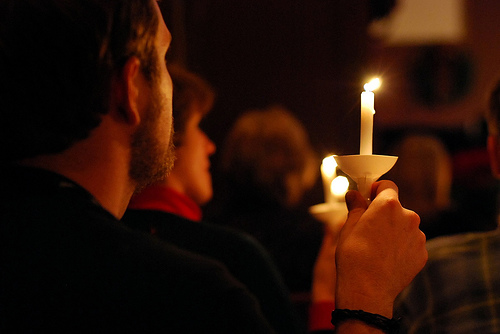
It does not take much imagination to see that this is not how life works. Life is full of tensions. The traditional worship of the church does not shy away from this.The traditional candlelight service held by many churches at Christmas and other times of the year provide a good example. Holiday sentimentality may account for their popularity but what makes them relevant? The relevancy of the candlelight service is located precisely in the tensions that are heightened by the darkness and the illumination of the flames. The service mirrors the time of year when the days are shorter, darkness sets in sooner and daylight is diminished. At the height of this growing darkness we light our homes, trees and communities.

But there is deeper water here, theologically and liturgically.The entire image, symbolism if you will, is of the light pushing back against the dark and overcoming it. This is a mid-winter service of protest against the powers of darkness and the coldness of death. The light represents hope in the midst of fear, seeing in the face of spiritual blindness, being together in the warmth of community whose only source of light and life and hope is Jesus Christ the Light of the world.

When these are the themes of the Christmas Eve candlelight service and its rituals, something relevant to the faith is actually being said and done. The ritual setting becomes Christian worship, not a holiday backdrop. It becomes part of the Law\Gospel proclamation rooted in the most basic paradigm of the faith – in the midst of death we live.

As our candles were lit at the close of the Christmas Eve ritual, and light filled the sanctuary, I spotted the young visitor. His voice, along with the rest of us carried the familiar song;


Silent night, holy night,

Son of God, love’s pure light;

Radiant beams from Thy holy face

With the dawn of redeeming grace,

Jesus, lord at Thy birth,

Jesus lord at thy birth.


A few moments later he came by me at the door and took my hand with a silent smile. There were tears in his eyes.


“May the peace of God that passes all understanding keep your hearts and minds in Christ Jesus our Lord.”


_

1 Peter 3:18

“For Christ also died for sins once for all, the just for the unjust, so that He might bring us to God,”

_

The great offense of the Christian faith is this: there is no other God than the crucified man Jesus. The meaning of the word God for the Christian faith means one thing and one thing only, the person of Jesus. For human beings Jesus is the final word of self-revelation, self-definition and self-affirmation of God. If God is the subject, the Crucified Jesus is the lone predicate.

The current wild objections to this run all the way back to the jeering bystanders who stood and watched Him die. “If you are the Son of God, come down from the cross!” He didn’t, of course, and this was proof enough for them that all God talk where Jesus was concerned was bunk. It never occurred to them that the deepest, clearest revelation of God for humans was right there in the ripped flesh, blood and death. It also hasn’t occurred to many in the churches.

Much of the onward and upward religion of today has ruled out this stark definition in favor of what people have always clamored for: an onward and upward, positive, uplifting, fulfilling and glory-filled God. Churches everywhere are throwing ladders against the walls of heaven, scrambling to free themselves from the bondage, suffering and confusion of the world, storm the halls of glory and grab a piece of divinity. But all this does is diminish God’s very self-revelation, the place where He wants to be known, and render the cross of Jesus useless. 

The proclamation of the Crucified Jesus for us in Word and sacrament  must be the singular point of contact for us. This because there is no pre-existing point of contact in us, no spark of divinity which God  fans like a sad ember into a roaring flame of faith. We must be met where we actually are, in the utter deadness of sin with no possibility in ourselves, I repeat, no possibility in ourselves at all to regain life and freedom from the powers of sin and death. God must become sin and death for us in order that He may be life for us.

This means that the Christian life has nothing whatsoever to do with the glory and praise religion of God seeking. In this life there will be no heaven ahead of time. Jesus did not die between two gilded candles on an altar, or in the midst of a hyper-ventilating praise band. He died between two criminals like you and me. That is still where he wants to be found, in the company of real sinners distinguished only by the knowledge of their great need.

For the Gospel of the crucified God grounds the Christian in the real world of hurts and hopes with our eyes wide open to things as they are. The Gospel of the Crucified God releases us from delusional spiritual pursuits that we may be what we were intended to be; creatures who are content to be engaged in the practical affairs of daily living in that radical cross-carrying faith that is content to entrust the things of  God, to God, expecting nothing, as we await with Advent longing the future that God has promised.

“May the peace of God that passes all understanding keep your hearts and minds in Christ Jesus our Lord.”


_


_

John 10:28

“I give them eternal life, and they will never perish, and no one will snatch them out of my hand.”

_

For many Christians this is the season of Advent. Like all seasons of the church year, Advent amplifies themes that accompany the Christian life year-round.

Central to Advent is the theme of ‘hope’. But the Christian hope does not run off into a myriad of directions merely reflecting our plans, dreams and projects. The Christian hope is centered in Jesus Christ. Which is to say that whatever hopes we may entertain in our finite lives, they must give way, make room for the realization of a hope that is of an entirely different kind.

I believe it was the German Lutheran pastor and theologian Helmut Thielecke who observed that God has not entered the world in Christ only to shut the door of eternity behind him. To confess the gift of hope in Christ is to confess a hope that is not and cannot be grounded in ourselves. The very fact of the Incarnation of God in Jesus, the fact that eternity has entered history, is a sign of this. The fulfillment of the future is not simply the culmination of humanity’s projected dreams of peace and justice. The fulfillment of God’s kingdom will be just that, God’s bringing about something utterly new and not the coming together of strands by which humanity weaves the dreams of a utopia.

Although the fulfillment of the future is taken out of our hands, the promise of a new heaven and new earth sets up both goals and boundaries for our lives now. 

Since we know the broad parameters of the kingdom are sketched in the terms of faith, hope and love, the temporal goal of the Christian and the Church as a whole must be to fight against the powers in this life that would turn hope into despair, turn faith or trust inward on the self or on history, and pervert love into an endless number of misplaced loyalties which in the end is idolatry.

The boundaries of the promised kingdom also keep us from wandering off into Marxian, utopian dreams which would leave all prior generations in death with no share in its’ blessings. Instead the Christian hope reflects our belief in the resurrection of the dead, the sign that all people will be in proximity to the fulfillment of God’s promises, according to His will.

To hope in Jesus Christ is to believe that the weights of time and temporal life have lost their power to crush us into meaninglessness. This is precisely the hope that Jesus Himself held in His Father as he wept in the garden and hung on the bloody Cross. There is a new humanity coming. But as Christians we do not believe we will be lead by one another along paths of our own making to a self-made future. We are held in faith by the One who struggled in this life, as we must, and who entered into death, as we will, which will bring all our plans to nothing.

Therefore, in the final analysis, our hope extends into the vast, empty topography of death. For our final hope is that even as we lay bound in death’s cold grip we will hear our name, as the sheep knows the voice of the Shepherd. Then, like ancient Lazarus we will see with our eyes the One who has promised,  “I give them eternal life, and they will never perish, and no one will snatch them out of my hand.”

_

 “May the peace of God that passes all understanding  keep your hearts and minds in Christ Jesus our Lord.”


_

_

Galatians 5:1

680c60_e9a7f92d7c5d7b6672edfa20b297ccb5

_

“For freedom Christ has set us free…”

The Christian life is not on one of obligation but of permission. And herein lies a great dilemma. For freedom actually exposes us. And this is something we fear. We actually prefer prefabricated solutions to living. Not because these make us free but precisely because prefabricated solutions protect us from freedom, real freedom.

When that little bundle of unrealized wonderfulness called “Marky” Anderson came home from the hospital, my parents soon realized that I was also a bundle of something not quite so wonderful – stubborn willfulness, intent on having it my way. The game was on!  I had to be placed under strict limits and obligations established by my parents because I simply lacked the foundation to engage obligations and freedom responsibly. I was completely free and yet my use of freedom was utterly self-directed. My use of freedom revealed my bondage.This is why, along with all its’ joys, parenthood also placed on my folks the roles of accuser, arresting officer, prosecutor, judge and jailer. They were dealing with a creature who was incapable of managing freedom. It is only as I grew, and learned to live under the obligations of family life that I was released into the wider world and ever-expanding obligations.

The continuing refinement of obligation which begins with parenting and extends into the wider society through law, therefore, is not a process to provide freedom. It is a process which attempts to check the abuse of  a flawed freedom. The endless proliferation of laws in this country, for example, is a symptom of this abuse. It tells us, or should, that we are not free, not in the true sense. The same can be said for every people on earth. In this respect every state is – and must be – a “Nanny state”.

So, when St. Paul tells us that “Christ has set us free”, what sort of freedom is he speaking of? It surely cannot mean temporal freedom to do as we will, to simply have the ability to choose among options. Neither does it mean disengagement from life, having leisure time, independent wealth or being on vacation.

The freedom of the Christian is two things at once, actually. On the one hand Christian freedom is the gift of complete and total identification with Jesus Christ. All the benefits of Christ are given to the Christian. Nothing is held back. This is why Jesus could say, “When the Son makes you free, you are free indeed.”  We cannot and will not free ourselves. You and I must be made to be free, declared to be free as an expression of God’s grace. And this is precisely what happened to you in your baptism. The fact that so many object to infant baptism, for example, simply reveals the reaction of one who intends to stay bound to self-willing in the face of the terrifying freedom inherent in God’s grace. It’s just too much.

At the same time Christian freedom is total engagement in life. And it must be. For there can be no hiding behind prefabricated solutions for the freedom of faith. And this is what we recoil from. This is what we fear. The freedom God grants is so complete that we are thrust onto the stage of life as “lambs of among wolves”, seemingly unprepared for so great a freedom in a world so bound in its’ pretensions.  

The gift of God’s grace which comes from outside of us, therefore, is essential for our freedom and protection.  For God’s grace removes us from our bondage to rationality, emotion, reason and will in order that we may use all of these in the service of love, without expectations or guilt, which is the glorious freedom\bondage of the Christian life.


“May the peace of God that passes all understanding keep your hearts and minds in Christ Jesus our Lord.”


_

1 Peter 3:15

(Continued)

“…sanctify Christ as Lord in your hearts, always being ready to make a defense to everyone who asks you to give an account for the hope that is in you,…”

_

The last several days my comments have focused on the disconnect created by modern secularism between the traditional language of the faith and the actual experience of people as they live within the secular culture. The task of Christian witness is challenging at this point, to say the least.  Below are some observations and suggestions as we seek to give meaningful  witness to our Christian faith in this time and place. These posts are longer than usual, so bear with me!

_

IT’S A CHRISTIAN COMMUNITY, NOT A YACHT CLUB

Church life in a secular society has tended to become a largely privatized affair where witness means inviting people onto the private turf of the reservation where they must learn to absorb language and customs in specially constructed environments that are essentially alien to daily life. To consciously or unconsciously get around this, invitation to a church is often couched in terms pointing to how friendly the church is, the likability of the pastor, programs for the kids and the like. The same kind of things you might say when inviting someone to the yacht club.

What if, in response to the question, ‘Tell me about your church’,  we describe what God is doing in the congregation in baptism, the preached word, the Lord’s Supper and so forth. Many church members would actually think it odd to speak of their congregation in this way and would probably have difficulty doing so at any rate. Invitation is fine but it is not synonymous with Christian witness.

WHERE ARE THE UNIVERSAL CONNECTIONS?

A meaningful Christian witness seeks ways to speak the language of shared universal meaning that connects with the experience of people where they actually live and work. If the God we proclaim in the Christian witness does not appear to relate to the actual life and experience of every human being, it is not because God is not God and has stopped speaking. It may be because our language reflects a whittled-down god. To speak of God in terms that confine Him to the private reserves of the church, like some sort of cultic deity, would then be blasphemy. Then we do not have language that connects the Biblical God to every human being, the Lord of heaven and earth.

LANGUAGE WITH TEETH IN IT: MEANINGFUL ENGAGEMENT BUT NOT CONFORMITY

Consider this. When the early Church used the phrase ‘Jesus is Lord’, they were placing Him in deliberate competition with the Roman emperor, local rulers and the entire pantheon of pagan gods. This three-word confession touched the life of every citizen of the empire right where they lived. People in the Roman world got it. They knew exactly what the Christians were saying. They rejected it, but they understood it. The language was the language of the culture. This immediate and universal language with bite is what we aim for in Christian witness.

What language of meaning do we share in some universal fashion with all people today? For this is where the Christian witness may have some traction in speaking to our family members, neighbors, friends and business associates in ways that necessarily  give weight to our religious language.

At the same time we must be faithful to the Christian proclamation of Jesus Christ and His Gospel. For Lutheran Christians this means we seek, with integrity, to connect the language of the Cross, baptism, the Lord’s Supper, sin and salvation, law and gospel with the actual world we live in. Here are some things to think about in this regard.

RELIGION AND OUR MOST DEEPLY HELD VALUES

We might do well to re-think how we use terms like ‘religion’, words that are out there in the common culture. If we think of religion as a term that describes churchly matters it does us little good. But if we think of religion as pointing to how we value life and particularly the highest values that guide and control one’s life, the word takes on a much wider significance. For then religion may be discussed on the basis of how we actually live. Every person is continually revealing their highest values in what they do. If you could follow me around for a year and observe me, especially in moments of real crisis, you would have some sense of my life’s most important  values. We need to turn the word religion outward, away from churchly matters, so it can help us engage people at the point of their most deeply-held values. If someone says to you they are not religious, this may be a helpful way to frame the discussion.

THERE ARE NO UNBELIEVERS

This leads to another question. Is it really helpful to divide the world up into believers and unbelievers? In point of fact, every person is a believer in something or someone. Martin Luther used the word ‘trust’ and pointed out, quite rightly, that every person trusts a god, in the sense that every person looks to that from which they derive good and to which they turn for refuge in times of trouble. That god may be drugs, money, work, possessions, self, power, another person – anything will do. But belief or trust is not the exclusive property of the Christian faith or any faith. Every persons behaves, acts on the basis of what we trust.To engage people at this level of discussion is to engage them where life actually matters to them. 

WE ALL LIVE WITH THE MYSTERY – AND BURDEN – OF OUR EXISTENCE

Another area of life shared with all people is the sense of fate. We all experience aspects of life where we are controlled but have no control in return. And the two points in life where this is most true for all of us are birth and death. We have no choice in the matter of our birth and while we may have some say in the manner of our death we have no say in the fact of our death. Every person is continually faced with these questions; Where did I come from? Where am I going? Are we all simply fated victims of impersonal powers? Is life a meaningless accident?  Is there any basis for hope? You might be surprised at how often people have these things on their minds. How often are they on yours?

ACCOUNTABILITY AND THE HUMAN SENSE OF GUILT

Another area of our universal experience that leads to the question of God is in the awareness of our accountability. Along with this people have real sense of their insignificance in the vastness of the universe. Anyone who has ever walked through a major airport, among thousands of nameless strangers, knows what is to feel utterly insignificant. The structures of existence confront us with this. And it is the real experience of knowing we are potentially nothing, that drives us to gain some kind of foothold through power or prestige, to have our ‘five minutes of fame.’ But the very fact we seek to assert ourselves, to justify our existence, bears witness to our sense of accountability.  We all live with a sense of what we are and what we think we should be or ought to be. What does our understanding of God’s grace have to say to those who live under the relentless pressure of the ‘shoulds’ and ‘oughts’ of existence, often accompanied by a sense of failure? What does it say to you?

THIS WAY TO THE BREAD LINE

Christians are not called to form private religious clubs where we worship little cult deities, stuck in church buildings. To paraphrase Martin Luther, the only thing that sets us apart is that we have been brought into the shelter and handed the free lunch of God’s amazing grace. We are called to give faithful, hopeful and meaningful witness at those places where we are caught in life’s crucible, where people’s hurts and hopes are tangible. Christians sometimes forget that we are all, in the end, needy, hungry, homeless beggars in this life. 


The areas outlined above, it seems to me, are a common currency of meaning we share with those around us that give rise, quite naturally, to the question of God. And while they do not automatically lead to trust in the gracious God we know in Jesus Christ, they are points of contact where we may demonstrate some sensitivity, compassion, humility and solidarity with others around life’s most basic questions and struggles as we respond to God’s call to….

“…sanctify Christ as Lord in your hearts, always being ready to make a defense to everyone who asks you to give an account for the hope that is in you,…”

“May the peace of God that passes all understanding, keep your hearts and minds in Christ Jesus our Lord.”

_

1st Peter 3:15


(Continued from last post)


The disconnect between the central themes of the Church – it’s worship, liturgies, law and gospel, baptism, the Lord’s Supper, sin, salvation, etc. – and the daily experience of people has consequences. One of the more obvious of which is a shifting of the focus of the Church away from these, and the challenging communication problems they represent, to popular religion.

One popular alternative is moralism. Preachers of moralism are often greeted at the door with responses like, “Thank you for making clear what I am supposed to do to be a good Christian.” Talk about behavior is something everybody understands. There may not be any real intention to act on the preacher’s prescription but at least they heard something that is understandable. A cartoon in a magazine years ago depicted a woman coming out of church and saying to the pastor, “You make it sound so real.”  The cartoon was not meant to be funny.

Another aspect of the moralism approach is to focus on practical advice for daily living. This is especially popular today and accounts, at least in part, for the success of the mega-church phenomenon. The entrepreneurs of popular religion have found a  formula that works. Downplay the traditional language and forms of the faith and use the Bible as a book on how to do or be anything. Preaching concerns itself with financial advice, personal psychology, family therapy and a host of other topics that “make it sound so real.” One should not be too hard on those who preach such stuff. For in most cases it is the people that demand it and drive them to it. After all, if preachers don’t give me something practical, what good are they?

This leads to my second point, religion as private experience. What matters is what religion means to me. And it doesn’t matter too much what it is.This has great appeal to our egalitarian sense as Americans. And the beauty of it is that no one can argue with you. Your private religion can mean anything you want it to mean. The flip side of this of this privatization of religion, of course, is that it is very difficult to relate your meaning to someone else. If no one can refute it, neither can they share it. The content of the private experience of religion can be very close to orthodox Christian faith. At the same time it can be an expression of these other factors as well.

A third area in which we can see the disconnect between the language of the Church and daily life is in the tendency to speak of God only in relation to things that cannot be otherwise explained by reason. Two people are in car accident. One dies, the other lives. Two people go into the hospital with cancer. One dies, one goes home cancer-free. The survivors claim it was a miracle. Wherever the human factor can be excluded we have room for God language. Or, if religion is not for us, we may want to talk about ghosts, aliens or bigfoot.

The point is that religious language today is not required or necessary for an interpretation of our life or our culture. For many it is an option, even a very important option, but it is still an option. Religion occupies a place in life almost like a hobby. It is the kind of thing one drops if reduced to the essentials or if there is something better to do.

All of this is reflective of that secular self-understanding that was yesterday’s topic. And this secular-self understanding is in the guts of the modern world. We all share in its’ axioms to one degree or another. The challenge facing the orthodox Christian and the orthodox Christian community is to avoid the traps of reducing the Christian message to moralism, religious privatization and the relegation of our language to cover only that which is beyond explanation, while allowing the great themes of the faith to speak of God in Christ in ways that confront, challenge and illumine the actual world in which we find ourselves. That’s what we’ll take up in tomorrow’s blog.


“May the peace of God that passes all understanding keep your hearts and minds in Christ Jesus our Lord.”


_

1 Peter 3:15

“…but sanctify Christ as Lord in your hearts, always being ready to make a defense to everyone who asks you to give an account for the hope that is in you,…”


Several years ago Linda and I were in Venice, Italy on a Sunday morning and decided to attend worship in the church of Santa Maria della Salute pictured above. When we entered the sanctuary for the principle service of the week, the nave, the main seating area of the church, was empty. A few rows of chairs had been placed in the chancel or altar area of the church beyond the arch in the center of the picture and that is where 30 or 40 of us gathered.

This scene is played out in hundreds of church buildings all over Europe, increasingly in other parts of the world and in the United States. What has happened that could create such a disconnect between the people who invested themselves and their communities to such an extent that buildings such as these could be raised at enormous cost and great effort, and the people of today?

The short answer is that secularism has resulted in this disconnect. And this disconnect is most clearly seen and felt in the failure of the traditional language of the Church to speak to the experience of people today.  The hypothesis of God is simply not needed by millions of people today in order to inhabit the institutions and roles of society. This secular self-understanding is quite at odds with much of the Church’s language and it is so difficult to deal with because it embodies axioms we do not even bother to question.  They are in the cultural air we breathe. And if you take a deep breath, in Venice, Italy or in Orange County, California, this is what you get:

First, life is the product of blind forces and blind chance. Natural forces are without mind and without purpose. Nothing is necessary. Everything is accidental. It is not hard to see how this cultural axiom conflicts profoundly with the Sunday morning confession, “I believe in God the Father, Creator of heaven and earth.” For six and and one half days a week we have to compartmentalize this belief in a Creator and then, on Sunday, confess one.

Second, you only go around once. This life is all you have. The good life is here and this is the only place you will find it. Massive amounts of wealth are deployed in the attempt to hang on to life for all we are worth. Death is the ultimate tragedy so we deny it as much as possible.  People don’t die, they ‘pass’. The dead are made to appear as if they are ‘sleeping’ or if that is too much we simply cremate the remains. Out of sight. out of mind.

Third, the language of absolutes is to be avoided. We must speak in the terms of relativism, opinions, climates, attitudes, feelings. No one is right.  It is the height of folly to make claims for absolute truth. Religion is privatized.  I just happen to be what I am by accident, because of the historical circumstances of my birth, etc.  In such a climate we are really quite unhappy with anything but pragmatic and temporary solutions. No one size fits all, please.

Fourth, you and I are on our own in the world. We make our own meaning. I’ll do it on my own if I can, in community with others if I must, but meaning is self-created.

With this cultural oxygen passing through our lungs, no wonder it’s easier to find people to serve as church treasurer or on the property committee than lead Bible studies. I can balance the checkbook and change a light bulb but how do I speak the language of God in such an environment?

For many today the churches are perceived as peripheral and irrelevant, where language speaks about a cult deity around whom a few people gather but not a God that necessarily must lead to the use of religious language that speaks meaningfully to all aspects of daily life.


(To be Continued)


“May the peace of God that passes all understanding keep your hearts and minds in Christ Jesus our Lord.”


_