

1 Corinthians 15:3

_

“I delivered to you as of first importance what I also received, that Christ died for our sins according to the Scriptures, that he was buried, that he was raised on the third day in accordance with the scriptures.”

_

In this political season I commend to you the following article by Pastor Rolf Hanson. I served as Rolf’s youth director during my last year at the seminary and learned much from him about ministry. This post is a bit longer than usual but worth the read. There is much wisdom here…and a challenge to those who use the puplit to advance political agendas.

Politics in the Pulpit: A Way to Supplant the Gospel

Word and Word, 1988

Rolf G. Hanson

In the branch of Lutheranism where I was raised, instructed, and ordained, the sermon was an exposition of the Word of God that declared the forgiveness of sins. The gospel was the message of the love of God in Jesus Christ, of Jesus’ gracious and merciful act which has purchased, freed, and redeemed people from their lostness and guilt. It was a message that called forth faith. The gospel was not an appeal for a budget, a report from a church convention or church auxiliary, an environmental, political, social or educational commercial, or a travelogue by the bishop or a missionary on furlough; nor was the pulpit time to be taken over by a clown show, musical presentation, or some other form of show and tell.

My preachers and teachers believed that people were created to be in a certain relationship to God, and they wanted everyone to know assuredly how that relationship came about. They knew, as St. Paul has taught, that if a person were in that right relationship with God the right relationship to one another would inevitably follow.

My mentors were not isolated or insensitive to the ills and meanness of life on this planet. They lived in it. One set of my grandparents lost seven children in five weeks to diptheria. My grandfather found his greatest consolation in his belief that Jesus, as the Scriptures told him, had ascended to the right hand of the Father. He could never understand why the Lutherans he knew in America didn’t make much of a fuss over Ascension Day.

My father left seminary to join the Navy medical Corps in W.W.I and spent his time with the wounded and dying. In my childhood home my parents provided shelter for an uncle ruined by the depression, numerous girls who were moving out into society from a Wisconsin orphanage, and an invalid grandmother whose witness to the gospel had great inspiration for our lives. My father believed the pulpit was too important to discuss anything but what St. Paul told the Corinthians: “I delivered to you as of first importance what I also received, that Christ died for our sins according to the Scriptures, that he was buried, that he was raised on the third day in accordance with the scriptures.” My father and my professors believed the point of departure in time was the cross and not the amoeba. The call of Christianity was not first and foremost a call to good works, to do away with evil, to straighten out either Caesar or Caiaphas, not even a call to faith. The call of Christianity was a call to what St. John fingered as the Life – Jesus the Life of the people.

I have never seen, read or heard anything that convinces me that politics has any place in the pulpit. I do believe that it is the church’s assignment to make conditions in this world as good as possible and to so so by honorable means. It is also the church’s assignment not to associate those conditions with the Kingdom of God. I recall C.S.. Lewis once remarking that political sermons teach the parishioners nothing except what newspapers are taken at the rectory.

The gospel has exclusive rights to the Sunday morning pulpit. The preaching of the gospel is important because it is the power of God unto salvation. In every assembly of hearers there may be one or several who will be in a traumatic situation or be dead before the next Sunday. They need to be clearly reminded of the comfort of Christ’s resurrection.

On a recent Good Friday I went to a church home for the infirm to visit several parishioners. In the worship space of that place a congregation had gathered. The preacher was reminding them of the evils of illiteracy in the inner city; but the gospel declares the liberation from the enslavement to sin and death. That gospel of liberation is good news to those who know they are dying and great comfort to those who suddenly realize it. It is also courage to those who survive.

The preaching of the gospel is in total contrast to political opinions concerning justice. It declares, as Lutherans are supposed to know and as all should hear, the marvelous doctrine of grace. We receive forgiveness and righteousness before God by grace for Christ’s sake, through faith. That’s the theme in glory. The preaching of the gospel brings an eschatological emphasis which is not the same as what the politicians have in mind. It is like the assurance that my grandfather had – the final victory is Christ’s. Angels called this “Good News of Great Joy,” and it went far beyond a fair price for mutton.

The concern of the pulpit is not between a preacher and government, or a listener and antagonists; first and foremost it is about Christ and the sinner. The pulpit is too important for anything else.


“May the peace of God that passes all understanding keep your hearts and minds in Christ Jesus our Lord.”


_


Isaiah 29:16

_

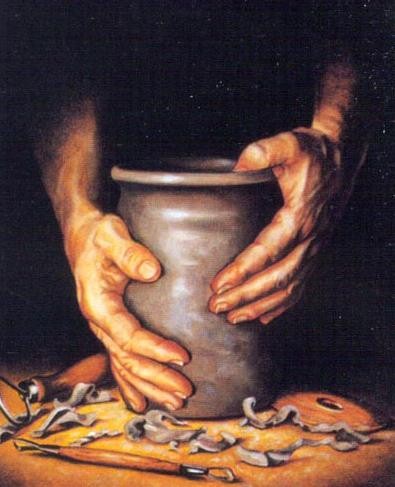
“You turn things upside down! Shall the potter be regarded as the clay, that the thing made should say of its maker, “He did not make me”; or the thing formed say of him who formed it, “He has no understanding?”

_

He sat in my study filled with guilt, clutching his Bible. He wore repentance like a thorny crown. Out poured the anecdotes as he gave evidence against himself. He seemed earnest, even sincere. But this was no confession. This was the perverted pride of self-loathing. He sought confirmation of his guilt, not his innocence in Christ.

I can think of nothing more wearisome or graceless than the piety of self-deprecation. When the New Testament says that Christians should not think more highly of ourselves than we ought, it is not prohibiting the healthy self-regard that accompanies a living faith. When we circulate around our sin and nurture our deficiencies, we miss the point of the Christian life. The promise of baptism is that we are in God’s hands. He has taken hold of us in Christ and has promised to keep us together with Him, making His life our own, giving us all the gifts of the Gospel.

In his wonderful book, Diary of an Old Soul,19th century author and pastor George MacDonald put it this way;


‘Tis that I am not good–that is enough;

I pry no farther–that is not the way.

Here, O my potter, is thy making stuff!

Set thy wheel going; let it whir and play.

The chips in me, the stones, the straws, the sand,

Cast them out with fine separating hand,

And make a vessel of thy yielding clay.


“May the peace of God that passes all understanding keep your hearts and minds in Christ Jesus our Lord.”


_

2 Corinthians 4


_

“So we do not lose heart. Even though our outer nature is wasting away, our inner nature is being renewed day by day. For this slight momentary affliction is preparing us for an eternal weight of glory beyond all measure, because we look not at what can be seen but at what cannot be seen; for what can be seen is temporary, but what cannot be seen is eternal.”

_

The photo above was taken at the ancient Greek city of Olympia. This ruined structure was once the workshop of Phidias, the greatest sculptor of classical antiquity. Phidias was responsible for the sculptural decoration of the famous Parthenon in Athens and the statue of the Olympian Zeus, one of the seven wonders of the ancient world. The workshop in the photo is where the statue of Zeus was made. None of the splendid works of Phidias have survived. His work is only known from a few Roman copies and images on coins. One of the greatest bodies of artistic work ever produced is simply gone.

The sobering lessons of history can be hard to learn. For all our blustering and stamping about on this tiny, celestial ball  the fact remains we are mortal creatures in a temporal existence. Human workmanship, even at its’ most glorious, eventually goes to dust and so do we. Nothing we put our hands to will stand the test of time. This does not have to be defended but it does need to be said.

The work of restoration that was begun 2,000 years ago at the cross of Christ is contemporaneous with our lives today. For even as the produce of human history is perpetually plowed back into the earth, the renewing, saving Word of the Gospel continues to create new people in Christ. The temporal consequences of the human story lead to a dead-end future. The eternal consequences of God’s work lead to an eternal future where what He has created in Christ Jesus will remain, pure and undefiled forever.


“May the peace of God that passes all understanding keep your hearts and minds in Christ Jesus our Lord.”


_

Psalm 20:2

_

“The Lord gives me light and saves me. O whom shall I be afraid?”

_

People who live in the countries with the most formidable armaments, the greatest economic power and the most advanced social and medical developments are supposed to be the most secure. The latin word ‘securitas’, from which our word ‘security’ derives, actually suggests a condition of being free from care. How about you? Are you secure, free from care? Probably not. 

No matter how hard we try, life simply does not result in being free from care. This is especially true in a society that bases security on externals, on possessions, money, power, appearance, and so forth. Searching for freedom from care among these things is tantamount to “looking for love in all the wrong places.” Search all you want in these places, you wont find freedom from the cares of life. What you will find is a constant diet of gnawing fear, tension and insecurity. 

Jesus spoke of living in the opposite direction. Instead of becoming a sad cliche’ and grasping at all the usual securities, Jesus said that the key to finding life is to lose it. Or, we might say, let go of it. The search for security is, in the end, an expression of fear that drives us back into ourselves, into all sorts of silly efforts at self-preservation. The life of faith is lived outward and is expressed in a bold, joyful daring.

No one who has stood at the foot of the cross and beheld the dying form of our Lord Jesus ever need fear again. This does not to say that a living faith in Jesus Christ is not utterly beset by conflicts, struggles and troubles. At the same time this faith is utterly secure. For the freedom of Christian faith has no need to expect or desire anything beyond that which comes from God’s gracious, caring hand.


“May the peace of God that passes all understanding keep your hearts and minds in Christ Jesus our Lord.”


_

Revelation 19:7-8

_

“Let us rejoice and be glad and give him glory!

For the wedding of the Lamb has come,

 and his bride has made herself ready.”

_

There is something about the Christian life that is similar to engagement. It is tentative. Or, we could say, incomplete, even unsatisfactory. I have sat with engaged couples over the years who had begun to question their intention to marry. They were usually dismayed at this but my counsel to them was that this is what engagement periods are for. An engagement period is supposed to be a time of searching and testing, a step toward the public promises of marriage. It is not the time of fulfillment and it may be the time that leads to the decision to go separate ways.

The important thing in this period of their life is that they learn to be faithful to one another. The time of engagement is the time of learning to trust. There is hope and love, too. But it is not until marriage that they discover the “greatest of these is love.”

So now in this life we live in faith and hope. Our love is immature. But when Christ Jesus comes again, when the Bridegroom comes to claim His bride, we will experience the full depth of His perfect love and realize why our faith and hope were not in vain. Christ’s presence will be overwhelming, His purpose so obvious, His love so completely satisfying, that all doubts will be stilled and all longings fulfilled.


“May the peace of God that passes all understanding keep your hearts and minds in Christ Jesus our Lord.”

_
Hebrews 13:5

_

“I will never leave you or forsake you.”

_

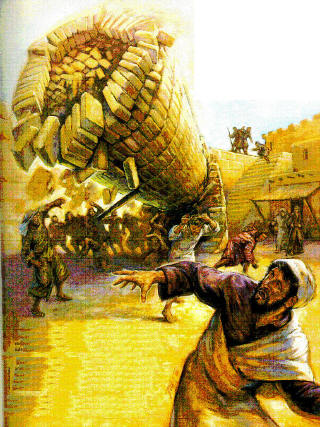
In the southern district of ancient Jerusalem stood the tower of Siloam. At some point during the ministry of Jesus the tower collapsed killing eighteen people. The Lord asked His disciples, “Do you think they were worse offenders than all the others who live in Jerusalem? No, I tell you…”

Pain and suffering are realities that we must deal with one way or another. We may attempt to discover a cause, and that can be good. Pain can be our salvation, for example, when we realize that some changes must be made. Children learn not to touch a shot stove. An accident may teach us to drive more carefully. The lessons to be learned through many types of suffering may be quite simple: Humans are mortal and safety pays.

We may also look for answers where there are none. Our determination to find answers may result in us coming up with the wrong ones. We may look at ourselves and ask, “What have I done that God should punish me like this?” Or, we may blame others, even God, and say, “Why me? I’ve been a good person. I don’t deserve this. God isn’t fair.”

If there are no obvious answers to pain and suffering it may be more beneficial to accept our suffering as something that is common to many and understand that nothing terribly unusual has happened to us. We have a lot of fellow sufferers. Instead of groping for answers or blaming how about sharing our distress with others? Many around us would appreciate the opportunity to offer support and comfort. And we may do the same for others so they know they are not alone.

God has promised that one day we will enter the perfect joy of His eternal kingdom where pain and suffering will be no more. Until then, our loving and merciful God who in Christ Jesus experienced torn flesh, burning thorns, utter loneliness and rejection has given us His this assurance; “I will never leave you of forsake you.”  Sometimes, perhaps most of the time, it is not answers we need but the comfort and assurance of His presence.


“May the peace of God that passes all understanding keep your hearts and minds in Christ Jesus our Lord.”


_

Luke 7:49

“Who is this that forgives sins?”

_

If a best friend lets you down, betrays your trust, your relationship is of a different character than it was before. Probably all of us at one time or another have been on one side of these dynamics or the other. Humanly speaking we do not seem to have the emotional equipment to deal with faithlessness.

Now let’s invite Jesus into the picture. He not only dealt with faithless people, but He also talks about forgiveness in a different way than anybody else. The people of His day were amazed at things He said, and they asked, “Who is this that forgives sins?”

Jesus not only forgave sins that were considered unforgivable in those days, but He also forgave His best friends when they proved faithless to Him.  They had glorious opportunities to stand up and be counted as His friends. But they let Him down.

There is an old legend that tells of Jesus meeting Satan out in the desert just prior to His Ascension into heaven. Satan mocked the Lord for being so foolish as to think that His faithless followers would ever make it without His visible presence among them.  The Lord replied that His disciples would trust Him and go out into the world in His name. But Satan just laughed.

As it turned out, every one of His disciples, after Judas, was faithful unto death. They were faithful because their Lord forgave their faithlessness and remembered their sins no more.

The disciples went on to do glorious things in Christ’s name. Do you think of yourself as too ordinary, too faithless to be of much good for Christ?  Your lack of faith is not the story. He is always faithful. He not only forgives your sins, He forgets them. Don’t be surprised if you find yourself with glorious opportunities to serve Him. In baptism He has chosen you. The promise of His forgiveness makes all things new. There is nothing ordinary about you, for you have an extraordinary Lord!


“May the peace of God that passes all understanding keep your hearts and minds in Christ Jesus our Lord.”


_

Acts 1:6

_

“Lord, will you at this time restore the kingdom to David?” 

_

The Lord’s disciples wondered aloud if He had come to restore the kingdom of David. Jesus was dismayed and said, “Have I been with you so long and you still don’t understand?” The mother of James and John asked the Lord that her two boys might have positions of honor and authority in His new kingdom. She envisioned them sitting on either side of the Lord’s throne. Jesus retorted that she had no idea what she was asking. Pontius Pilate asked if Jesus was a king. He replied, yes, except His kingdom was not of this world.  On the day of the Ascension, as Jesus was taken up to heaven, the disciples were still asking, “Lord, will you at this time restore the kingdom to David?” They just didn’t get it.

Political passions are running high these days. What else is new. The push and pull of politics is as old as dirt – and at times worth about as much.  It isn’t that we can dispense with politics, with earthly governance. All forms of governance are expressions of law. Some forms are better than others, but all have their temporary place in the management of human affairs. Power is at stake, of course. And wherever power is at stake, expect it to bring out the worst in people. Politics has a way of doing that. Look again at the disciples. My suspicion is that all this high-minded talk about the kingdom of David had something to do with political payback, gaining the high ground, sticking it to the Romans. The blatant political self-interest of the mother of James and John was so embarrassingly obvious, Jesus waived it aside with a word.

The Lord had His opportunity, when he stood before the Roman governor, to lay out His politics, His platform, His agenda. The political sensibilities of a Roman politician like Pontius Pilate were tuned to a high pitch. If he had sensed the remotest threat in Jesus it would have been enough to remove Him. But after examining Jesus, a relieved Pilate said, “I find no fault (read, threat) in Him.” He seemed to grasp what the disciples could not. 

Jesus did not come to establish an earthly kingdom. You’d never know it, however, when you listen to many Christian voices – on the left and right – who claim to speak for God. Your voice might be in this chorus. While we wait for the new heaven and the new earth we must still live here. But this transitory life, so full of difficulty and conflict, can cause the Christian to lose sight of the goal and we can go astray and be consumed by the passions of politics. So we need to hear again how Jesus responded to these misplaced passions among His own. For that is the caveat.

Do you, Christian, have more passion for the lords of this world than the Lord of the Church? 


“May the peace of God keep your hearts and minds in Christ Jesus our Lord.”


_

Matthew 13:44

 _

“The kingdom of heaven is like a treasure hidden in the field, which a man found and hid again; and from joy over it he goes and sells all that he has and buys that field.”

_

In His book, Bible Windows, author Ivar Powell tells the story of a rich man who died and left no heirs and, apparently, no will. When his household goods were auctioned, the bidding was fast and furious until a small painting of the dead man’s son was brought forward. The painting had been cherished by the wealthy father because the boy died at an early age.The auctioneer did his best but the crowd showed no interest. Finally, a frail, elderly woman in drab garments placed a small bid and the painting was hers. She had been the boy’s nurse when he was a baby and had loved him dearly. Later, as she examined the painting closely, she noticed a bulge in the backing. Making a small cut, she removed an envelope which turned out to be the man’s missing will. The document stated very clearly that he wanted to leave his entire fortune to the person who still held dear the memory of his beloved son.

There are many facets of church life that draw our attention. Those who desire structure may be drawn to its’ institutional aspects. Others with an aesthetic interest may be drawn to its’ rich musical and artistic heritage. Still others see value in the church’s social concern, youth programs or congenial fellowship. The “bidding wars” over these matters in church life can be fierce. But they are penultimate matters at best.  Preoccupation with them can blind us to the great center of church’s life.

The priceless treasure of the Church is Jesus Christ. In Him God has revealed His will and grace, His determination to forgive sins. In a real sense, if we have all the things mentioned above but do not have Christ, we have nothing of any lasting value. If we have Him, though we are poor in every other way, we can say with joy and gratitude that we are rich. 


“May the peace of God that passes all understaning keep your hearts and minds in Christ Jesus our Lord.”


_

Romans 13:10

_

“Love does no wrong to a neighbor; therefore love is the fulfillment of the law.”

_

The first major storm of the hurricane season recently came on shore near New Orleans. Unwelcome flood waters drove many from their homes. News reporters stood in the withering downpours, like battlefield journalists, giving blow by blow descriptions of the storm and its’ progress. They brought us live pictures of driving rain, devastaing winds and the valiant efforts of people as they struggled to stand against  the onslaught.

We are also in another storm of sorts. It is has far more power than many hurricanes, inflicts untold amounts of damage and roars through the world virtually unchecked. That storm is the willfulness and assertion of the unrestrained self.

This is no more apparent than in contemporary efforts to redefine marriage to include same sex unions. Advocates of this particular expression of willfulness are storming across the landscape, putting the culture on the defensive. Like all storms, the effects of this movement are not to build up but to destroy. The millions of selves that are wittingly or unwittingly engaged in this effort are well on their way. And this is but one issue among many.

Self-indulgence and unfettered self-expression have become politically correct, even ‘chic’. But this storm of self-expression is wreaking havoc on our society. Hedonism is no joke.

Christian people are called to stand against the maelstrom of human willfulness. And this begins with the self.  At times, this requires from me a return to the diminutive, to repentance. It may also require me to support  the application of human law in defense of society and its’ interests.

At all times the Christian is called to stand against the chaotic forces within life with the law of love. This is the God-given place of tranquility within the eye of the storm. This law is always defining for us and seeks to do no harm to the self or the neighbor. As St. Paul has reminded us,


Love is patient and kind; love does not envy or boast; it is not arrogant or rude. It does not insist on its own way; it is not irritable or resentful;it does not rejoice at wrongdoing, but rejoices with the truth. Love bears all things, believes all things, hopes all things, endures all things.”


“May the peace of God that passes all understanding keep your hearts and minds in Christ Jesus our Lord.”


_