
John 1:17


“For the law was given through Moses; grace and truth came through Jesus Christ.”

_

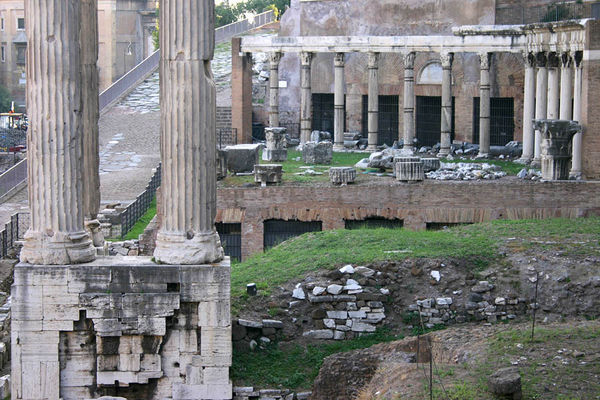
The columned portico in the background of the photo above is located in the Roman Forum. Six pairs of golden statues representing the principal Greek and Roman gods, male and female, were displayed in the large rectangular shrines behind the portico. It is called the ‘Portico of the Harmonious Gods’. Disharmonious may have been a better word.

The Greek and Roman myths depict gods who were capricious and unreliable. They might favor you or they might go against you. You could never be certain. They often fought among themselves and were known to take out their jealousies on unsuspecting humans. At least part of the role of ancient religion, therefore, was designed to keep the gods off your back!

Into this puzzle of ancient religions came the God of Israel with a covenant. Do this and you will be rewarded. Fail to do this and you will be punished. This covenant relationship spoke not to a world of capricious uncertainty but to a world of order. This was a great advance over the multitude of gods and godesses and religious cults… but it is not good enough.

Just suppose that were the end of the story where God is concerned, that He punishes and rewards and no more. That would mean that everyone would get what they deserve. No more and no less. That would be the law of justice. Justice has its important place in life. But those who think that justice will create a harmonious world are deluding themselves. The unrelenting application of justice results in two kinds of people; the proud and the despairing.

Blind to the truth of God, the ancients observed the capriciousness and injustice reflected in their own lives, and the world, and assumed that whatever gods may be must also share these characteristics.Through Moses and the prophets, God took the initiative and revealed to humanity that the universe is one of law, order and justice, giving us what we deserve.

In Jesus Christ, God has moved beyond  law and justice revealing that mercy, love and forgiveness, which lie most deeply in His heart, are His gifts to us, the undeserving.


“May the peace of God that passes all understanding keep your hearts and minds in Christ Jesus our Lord.”


_

2 Corinthians 4:16-18

_

 Therefore we do not lose heart. Though outwardly we are wasting away, yet inwardly we are being renewed day by day.  For our light and momentary troubles are achieving for us an eternal glory that far outweighs them all.  So we fix our eyes not on what is seen, but on what is unseen, since what is seen is temporary, but what is unseen is eternal.”

_

Years ago I was hiking in a dense forest. I left the trail to do some exploring but soon lost my way in a maze of trees. A nearby hill provided the proper perspective from which I was able to regain my bearings

The world is more than ready to invite you to keep focused on the tree and not the forest. And nothing can rob the Christian life of its’ joy faster than narrowing in on your problems, as if they are the defining reality in life.  St. Paul says differently. Look to what you cannot see. 

The outward person is subject to all kinds of wear and tear in this life. There is nothing unusual or exceptional about having all sorts of problems. This sets us up, of course, to believe that the sum total of life is to get about either avoiding or solving these problems. For many people this is, essentially, what life amounts to. But not for the Christian.

The Christian life is one of perpetual renewal. Each day, Christ Jesus brings us to the vantage point from which we may behold  the troubles of this life from the vast vista of His grace.

Earthly troubles will last only a little while, but the glory of heaven will endure forever. Do not concentrate on your earthly troubles as if they are greater than the One who is in you. They are not. But the unseen things do not only reside in the realm of hope. The Holy Spirit has been given to you. God Himself hovers over your life, turning everything to good, bringing life out of all those little deaths that preoccupy you so.

The world obsesses on its’ aches and pains, giving them too high a place. The Christian lives each day from the vantage point of the hilltop, mindful of the struggles, but held in that vision of the final victory that is ours through our Lord Jesus Christ.


“May the peace of God that passes all understanding keep your hearts and minds in Christ Jesus our Lord.”


_

Psalm 139:7

_

“Where can I go from Your Spirit? Or where can I flee from Your presence?”

_

A woman once came to see me who was on a self-described journey of discovery. She was looking for faith but it was elusive. She believed the problems of daily living, difficulties with others and her own faults were impedeing her progress.  I asked her to consider that perhaps these obstacles in her life might actually be the means God was using to drive her to faith. Not a generic faith, but to a faith that relied on Christ and His promises. She wasn’t so sure.

The journey of authentic faith must always be a tutorial passage. It’s not so much a passage of  willing discovery as it is a passage over which we are driven against our wills. Like a ship that sets sail for one destination and is driven by the winds in an entirely different direction. Those winds are the law of God, driving us in the Spirit  from the self-willed destinations of our own choosing, toward the God-willed faith that is His gift in Christ Jesus. 

As long as we are in this life, the Holy Spirit haunts us by exposing our failure to fulfill our existence. Our great worth before God demands nothing less. Our sin is so great because our value is so great. The following lines from the poem by Francis Thompson entitled, ‘The Hound of heaven’, tell of this God who relentlessly pursues us in the midst of life.

I FLED Him, down the nights and down the days;
  I fled Him, down the arches of the years;
I fled Him, down the labyrinthine ways
    Of my own mind; and in the mist of tears
I hid from Him, and under running laughter.  
      Up vistaed hopes I sped;
      And shot, precipitated,
Adown Titanic glooms of chasmèd fears,
  From those strong Feet that followed, followed after.
      But with unhurrying chase,  
      And unperturbèd pace,
Deliberate speed, majestic instancy,
      They beat—and a Voice beat
      More instant than the Feet—
‘All things betray thee, who betrayest Me.’


“May the peace of God that passes all understanding keep your hearts and minds in Christ Jesus our Lord.”


_

2 Corinthians 5:19

“For God was in Christ, reconciling the world to himself, no longer counting people’s sins against them. And he gave us this wonderful message of reconciliation.”

_

I recently pulled into a gas station only to be greeted by an actor displayed on a video screen mounted in the gas pump. This was followed by a young woman giving a brief news update! At the gas station? Sure, why not. The marketing execs at this company must have figured that since we all run around with our noses in some kind of screen all day long anyway – ipads, iphones, whatever –  why not jump on the bandwagon? Actually, it was kind of cool! I suppose the idea was to make me feel like I was ‘connected’. 

I love gadgets and all the great ‘techno’ stuff available today. At the same time the technological brilliance and obvious utility of gadgets cannot finally address our fundamental sense of estrangement.  They can only connect us to a point. In fact, they can sometimes make the sense of estrangement more vivid. 

Many things go into forming an authentic human life but love is absolutely essential. It is the key ingredient. Without love there can be no authentic connection. Give me a tender word, a warm embrace, a true friend and big hug any day over a phone full of apps or millions of pixels bombarding my eyeballs!

But more than this there is a love which so deep and so enduring it is able to connect the human heart with the heart of the Living God. That is the love we know in Jesus Christ. If human ingenuity can connect our divided world through communication technology; how much more deeply and substantially can the Spirit of God reconcile and unite us through the power of His love in Jesus Christ?


“May the peace of Christ that passes all understanding keep your hearts and minds in Christ Jesus our Lord.”

_

1 Corinthians 12:13

“For by one Spirit we were all baptized into one body — Jews or Greeks, slaves or free — and all were made to drink of one Spirit.”

_

Many people have an aversion to what they call “organized religion”. It’s a bit puzzling, if you think about it. Can you name any regular activity or gathering of human beings that is not organized in some way?  The objection to the organized character of religion can’t really be aimed at being organzied. What’s to be preferred? Disorganzied religion?

The objection to organized religion, it seems to me, prefers to assert the individual over the community. No wonder Americans have taken to this brand of ‘Christianism’, where an internalized, experiential form of religion seeks God within the self. I’ve heard people say that all they need is a personal relationship with Jesus and that being part of a church community does not matter. These folks need to pay attention to that Bible they claim to like so much.

To claim that all that matters is a personal relationship with God is to deny how God Himself has defined the character of the Christian life. “We were all baptized into one body”, the Bible says. Oops!  There’s that nasty word “We”. Like it or not, if you have been given the Holy Spirit, you belong with all those who share that Spirit. To be Christian is to be baptized into a community of faith.

So, here’s some advice. Forget your spiritual naval gazing or traveling down that bogus, dead-end road called your personal experience. The only god you will find there is one of your own making. If you want to know what being in the Spirit is all about, look around you at the folks in church on Sunday morning who have gathered around word and sacrament. This messy, inconvenient bunch of sinners may not fit with your personalized view of religion, but it is definitely God’s idea of what it means to be Church. He has organized it that way. 


“May the peace of God that passes all understanding keep your hearts and minds in Christ Jesus our Lord.”

_

Lamentations 3

“Thy mercies are new every morning; great is Thy faithfulness.”

_

We fight repetition. And in fighting it we redouble our efforts to increase variety. Those in the marketing business – and in politics -figured this out long ago. So, they continually assist us in fleeing repetition by offering us the next big thing, variety, change.

This formula keeps working because most of what we consume in this constant diet of change does not satisfy. In fact, it leads to increased restlessness and boredom. What this ought to be revealing to us is that we do not fight boredom with constant change.

I have written previously on this blog about how this insatiable desire to flee boredom has infected the worship of many churches. The objection “It’s boring”, is the common complaint we hear. Actually, the issue is not that worship is boring. The issue which ought to be confronted in those of you who voice this complaint is why should the church become an accomplice in your restless efforts to relieve yourself of boredom?

All life is repetition. Daily life is made up of all kinds of repetitive patterns, habits and rituals. We address boredom not by mindlessly chasing the new but by investing repetition with great meaning. If you cannot see the depth of meaning and value in the little repetitions, the little liturgies of daily life, don’t expect meaning to result from your efforts to run from them.

My grandmother Anderson started each day by spending some time with her Bible. This was something she praticed all of her life. After her time with the Scriptures she went on with her day. The activities she had planned rarely changed; shopping on one day, laundry on another and so forth. I lived with her for a time after my grandfather died. She never struck me as someone who was bored with the ordered life she lived. In the simple, repetitive tasks of daily living she saw greater meaning.

The results of tuning your life to fads and distractions is predicatble: restlessness, boredom, pessimism. A life tuned to the Word of God greets each day with gratitude, anticipating that new word from Him whose mercy makes all things new.


“May the peace of God that passes all understanding keep your hearts and minds in Christ Jesus our Lord.”


_

Psalm 90:14

_

“Satisfy us in the morning with your steadfast love, that we may rejoice and be glad all our days.”

_

There once was a sea captain who, after many years, was able to purchase a brand new sailing ship. Three huge masts carried enough sail to make it among the fastest of its class. It was well-equipped in every way. After more years of sailing the captain finally arranged for a cargo that would make him financially independent. The ship made excellent time and came to an island where it dropped anchor. The captain was rowed ashore, presented himself to the harbormaster and asked to be directed to the company where his cargo was to be delivered. The harbormaster replied, “I’m sorry sir, but you have arrived on the wrong island. This is not your destination.”

When we say that someone has aquired independent wealth we usually say that person has arrived.  Arrived implying the end of a journey aimed at such a result. What if it could be said that every person, throughout the entire world, has arrived? What if every person had financial security and access to anything and everything they desired? What if every person was educated in such a way that enabled them to use the full potential of their capabilities? What if this state of affairs caused all war and conflict to cease, injustice to end? Would we then have arrived, really arrived? No. For If these things were universally defined as the goal of living, the whole world would have gone wrong.

How well you manage life and accomplishment in this world is not the point of living. This is one dimension of the parable of the Prodigal Son. He squandered his life away in the far country. But if he had used his inheritance to make it, to arrive, he would still have missed the point of living. Why? Because he would have still been estranged from his father.

We do not have God in order to be successful, to be healthy, to have peace, or to avoid squandering our lives in this way or that.  God is not a means to an end. In a real sense God is the end of living, the destination, the point of it all. Having God, we have enough. The fact of the matter is that He hasn’t promised us anything else. He promised Himself and He gave Himself. God could have overwhelmed us with material prosperity and not made a dent in the celestial treasury. It would have cost him nothing. Like a rich man who buys friends and wives with money. 

But God has given what did cost. He gave Himself in Jesus. It cost Him a death on the cross. What this means for you and me is that to arrrive means to be with Him. When we have Him, we can truly say we have arrived. 


 “May the peace of God that passes all understanding keep your hearts and minds in Christ Jesus our Lord.”

_

2 Corinthians 5:17


“Therefore, if anyone is in Christ, he is a new creation; the old has gone, the new has come!”

_

If the 60’s generation has an anthem it must be ‘Woodstock’, the song about the famous rock concert written by Joni Mitchell and made popular by Crosby, Stills, Nash and Young.  The key lyric in the song is “…and we’ve got to get ourselves back to the garden.” The garden Joni Mitchell’s lyric refers to is the Garden of Eden. Woodstock was supposed to represent that return. The naive optimism of her generation hoped to realize a kind of utopian world of peace and love.  Far from being the repristination of The Garden, however, Woodstock turned out to be a giant rain-soaked mudbath. The Garden ended up being acres of land strewn with garbage –  and shattered illusions.

The story of Adam and Eve and the Garden of Eden, which modern theology dismisses as primitive and quaint, is actually quite an accurate and profound picture of humanity. The story tells us that we were created for God, for creation and for one another. We were created to take our greatest delight and joy in God, to live within the luxuriant abundance of creation and be lost in love for one another. The story goes on to reveal that a tragic break in all these relationships has resulted in the world as we know it. Now, we are estranged creatures; estranged from God, from the creation and from one another. The fact that Adam and Eve hid from God served to reveal that self-consciousness now dominated them. When one of their two sons went on to murder the other, the trajectory of the ascendant self was seen to be the inheritance of fallen man – and woman. 

We will not “…get ourselves back to the garden.”  Innocence is no longer possible for us. But God has promised a New Creation. In Jesus Christ that New Creation has begun. In God’s time, this old discordant creation will give way to the new. In the meantime, faith in God’s promises tempers the self so that the restoration may begin; that we may love one another, care for the world, and find our deepest joy in God Himself even as we look forward, in hope, to the final restoration of all things in Christ.


“May the peace of God that passes all understanding, keep your hearts and minds in Christ Jesus our Lord.”


_

John 12:5

“Why was this ointment not sold for three hundred denarii and given to the poor?”

_

It wasn’t Jesus who said this; it was Judas. As far as he was concerned, pouring expensive ointment on the feet of Jesus was a waste. Better to sell it and distribute the cash. Judas had no time for ‘Divine Wastefulness’.

There is a lot of waste and redundancy in nature. Many plants, for example, toss off bushels of seeds, most of which never take root and grow. Why has God created such a wasteful natural economy? Couldn’t we have gotten by with a few less snowflakes, flowers, mountains or lakes? Didn’t God go a bit far in creating such a luxurious world?

A man who was raised during the Great Depression once observed that his family saved everything from bits of string to used nails and old boards. In later years, after the Depression had lifted, he continued to save nearly everything. He spent money on only the necessities and was critical of anyone who spent in excess, as he understood it.. He allowed his experience of want to overshadow his abundance.

Surely, God expects us to use good stewardship and wisdom when we spend money, even for the church. But there is also such a thing as thinking we are economizing when we are simply being stingy.

God has gone over the top in providing for us; an abundant world points to an even more abundant grace. Many set the parameters of their generosity based on the shifting tides of the world’s economies. God’s people set their course for living by looking  to the economy of ‘Divine Wastefulness’ and the extravagance of God’s amazing grace, revealed supremely in Jesus Christ.


“May the peace of God that passes all understanding keep your hearts and minds in Christ Jesus our Lord.”

_


_

Proverbs 16:18

_

‘Pride goes before destruction, and a haughty spirit before a fall.’

_

The Lutheran Church has come down very hard on the fact that the will of man cannot produce a pure act, a pure choice.  But we have not been equally as firm on whether the mind can produce a pure thought, or proposition, or expression of the truth. There is something fraudulent about this. We have been quick to point out that to say I have done a pure act is a form of pride. We have not been quite as willing to apply the same conclusion to those who claim to produce a pure proposition or statement of truth. Yet, this claim can also be a reflection of pride. It has gotten the church into all kinds of trouble and continues to do so.

In the late nineteenth century, for example, the Norwegian Lutheran tradition was torn apart by what was called the ‘Election Controversy’. One group emphasized the sovreignty of God. Another group focused on the responsibility of man. Both sides stubbornly insisted on the truth of their position. It was not until 1917 that the rift was healed, but only in part. Statements by both groups were developed and approved. Although each one cancelled out the other, the church decided to live with both positions. This is but one example of numerous church conflicts that reflect the consequences of the pride of the mind, of thought, of reason.  

The Biblical view of man and woman is that of a creature that has been heavily compromised by sin. It is not only our actions that reflect this (and they are clear enough) but also our minds (this tends to be less clear). But pride, whatever form it takes, always has destructive, divisive consequences. 

Churches continue to hold doggedly to propositions of truth to such an extent that other churches are held at arms length or are shut out altogether. I confess, this is something I struggle with. At the same time I wonder: Are the truths we hold and confess best held in the proud battlements of the mind or in the humble synthesis of faith and love?


“May the peace of God that passes all understanding keep your hearts and minds in Christ Jesus our Lord.”


_