
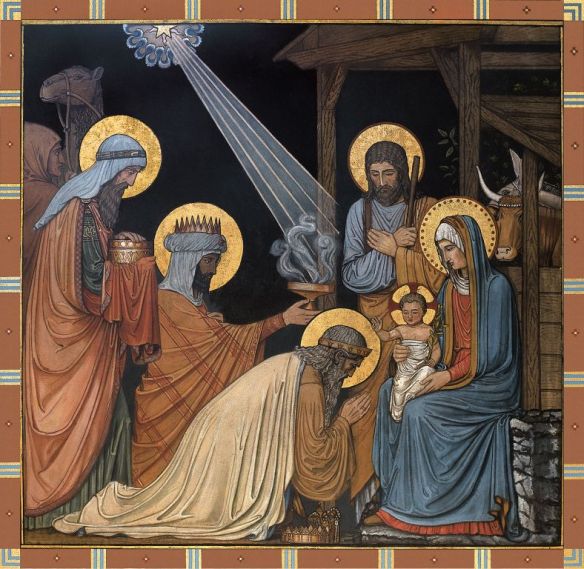
Matthew 2:10-11

680c60_ae07a1a5869d2e4816cef2ab0ee146f0

_

“When they saw the star, they rejoiced exceedingly with great joy; and going into the house they saw the child with Mary his mother, and they fell down and worshiped him.”

 _

The Christmas Festival presented us with familiar characters. Among the supporting cast were the three kings, the wise men. As I reflected on them again this year what struck me was how their their sumptuous gifts and silken robes seemed oddly out of place among the general rudeness of the manger scene. What are these royal intellectuals doing kneeling before a tiny child among animals and crusty shepherds out in the middle of nowhere?

The coming of Jesus was the in-breaking of the rule, the reign of God. Christmas signifies the divine invasion of a realm that had been usurped by the powers of evil and the forces of human willfulness. It’s important to state it this way because when the Church gathers for worship at Christmas, or any other time, what we are proclaiming to ourselves and to the world is our intent to desert  the human army of self-promoters and join the resistance for the sake of the rule, the reign of God in Jesus Christ.

With their gifts and obeisance, the wise men were acknowledging the One to whom their life’s obligations, energies and resources now belonged. The picture of kings kneeling is a picture of the transfer of allegiance, loyalty, duty, power. It was to Whom they knelt that matters. Trust, faith, is always defined by it’s object.

When you and I were baptized, we were given a name; God’s name. Our baptism, among other things, testified to the fact that we now belong to the God who we know as the Father, the Son and the Holy Spirit. Our baptism was a statement about who we belong to, who has the last word in our lives. For whoever has the last word is our God.

Baptism rearranges our loyalties, transfers our citizenship in such a way that we become the protagonists, representatives, advocates of the kingdom of God.  We proclaim “good news of great joy”, the reign of life in the midst of the reign of death. This means the shadow of Good Friday always falls over the Christmas manger. For we are not only the beneficiaries of God’s reign, we participate in God’s reign, which means we are carriers and proclaimers of the cross. 

You are not your own. In baptism he claimed you and gave you the Holy Spirit. The last Word belongs to God. At Christmas, the Christ mass, the Christ worship, you knelt before this God, this same God that was born to an unwed mother, surrounded by animal dung, smelly shepherds and kings who radically altered their allegiance. Watch out! If this is the God who has taken hold of you in baptism, who has the last word in your life, you just know that whatever life he has in store for you is not going to be business as usual!

 _

“May the peace of God that passes all understanding keep your hearts and minds in Christ Jesus our Lord.”


_

Galatians 6:1

“Brethren, if someone is caught in any wrongdoing, you who are spiritual should restore such a person with a gentle spirit, watching out for yourselves so you also won’t be tempted.”

_

The expression ‘radical inclusion’ is often used these days in some Christian circles to describe the character of God’s grace.

If radical inclusion describes grace, perhaps it would be useful to clarify just what grace actually is, and what it means to be a community of grace. For that is what the Church is, a community of grace. Grace certainly describes God’s undeserved, unconditional  love for sinners. St. Paul tell us that we are saved by this grace, apart from any contribution on our part. This is radical stuff.

We may also ask, what kind of life does this radical grace make possible? To put a fine point on it, grace makes it possible for us to take responsibility for our past, without condemnation, even as we assume new responsibilities as servants of God in the love and freedom grace makes possible. We are able to confess our sins and walk in a new life because of grace.

This means that the Church, the community of grace, is not a judgmental community. But we are an admonishing community. This distinction is critical.

The problem with some uses of radical inclusion to describe grace is that grace is actually being defined as ‘indulgence’, anything goes. If I indulge you, whether I really care about you is questionable. Good parents don’t indulge their children’s every whim unless they want to produce selfish, willful brats. Indulgence is not saying ‘I love you’. It is saying, ‘Go ahead, do what you want. I don’t care.’

The Church is a community of grace, a community of forgiveness and love. And because love is our aim, our way with one another is to care. And when you care, you admonish. And to admonish is to express warning or disapproval in a gentle, friendly and concerned manner. Admonition is not unloving criticism. Without admonition a very important aspect of love within the Christian community is not expressed, and at great cost. Love is not lazy, nor does it overlook the harm we may cause one another. Christians are neither unloving critics nor uncritical lovers.

There are any number of issues in church life that are defended in the name of radical inclusion. But it is fair to ask, in fact in the name of Christian love it must be asked, if radical inclusion really means nothing more than indulgent acquiescence to willfulness insisting on it’s own way. If this what is actually meant, it surely cannot be grace. Nor can it rightly be called love. In fact, it can hardly be called Christian. 

_

“May the peace of God that passes all understanding keep your hearts and minds in Christ Jesus our Lord.”


_

Reflections on Worship and Some Implications for Christmas

_

Today’s blog is a continuation from Wednesday and begins with the question that ended yesterday’s entry; What kinds of experiences, common to us all, come to expression in the language and action of worship? Here are a few things to consider.

_

First, the language and action of worship confront us with the common experience that we are not self-caused or self-perpetuating. Every person is thrust into the world with no say in the matter. Our place of origin, parents, physical characteristics, and so forth, are out of our control. The basic questions of our ultimate origin – and therefore our ultimate goal – remain unanswered. To worship is to respond to these questions.

To be born into pre-existing structures of choice means we must choose, and those choices result in the shaping of our lives, relationships and the world. We have no choice when it comes to choice.This means that worship is going on all the time for every person, every day, in every moment as we entrust ourselves to the little gods, the little stories, the redemptive projects of our own making in the effort to justify our choices and, therefore, our presence in the world. 

Second, the language and action of worship confront us with these tendencies to self-validation, to idolatry, to bad worship and the harm it does. If it does not, worship ceases to be Christian in any meaningful sense and the false gods of self-affirmation we bring with us in the door every Sunday actually are the object of our worship. Every gathering of Christian worship, therefore, confronts each person and the community with the consequences of bad choices, bad worship, so that a story large enough to encompass all our stories may inform and redeem us, turning us from bad worshipers to worshipers of the Living God. This is what the confession and absolution, the proclamation of law and gospel intend to accomplish. In worship we are graciously brought to confess our need for a savior and we are given the Savior we need.  

Since we are approaching Christmas, a few words regarding how this may apply to Christmas worship may be illustrative. Whatever else the Christmas observance may be about, the Scriptures make it clear that what we are seeing here is God’s invasion of hostile territory. The angels anticipate this in their invitation to drop fear as God comes near. They know who they are dealing with. Fear, anxiety over the threats inherent in life, is the atmosphere in which we live. The appearance of the new, the strange, the unknown is the occasion for fear and suspicion, not automatic joy, because we are by nature frightened and suspicious, uncertain about ourselves and our place in the world.

Christmas worship, therefore, must avoid the trap of falling into the false comfort of feel-good sentimentality. Pretty lights and pretty songs do not Christmas make. For “good news of great joy” has come to us, it does not originate with us. And that good news is that a Savior has been given to us, we who actually live as if we have no need of one. 

So the language of choice that is central in Christian worship is the language of God’s choosing to be with sinners, the lost, frightened, anxious ones. This is the great joy of Christmas. “For born to you this day…is a Savior…”. Jesus integrates the frightened human story with the grace, love and mercy of the Father. He gives meaning, in every sense, to our lives, and inhabits our lives in such a way that we no longer need fear the consequences of our choices. Because God is for us, we are free to live joyfully, expectantly in the fearlessness of faith.

Christmas is a good time to sugar coat plumbs and cookies but not Christian worship.The job of Christian worship at all times and seasons is to hit the high notes of our great joy in Jesus Christ without muting the low notes that sound the mournful sobriety of our great need.


“May the peace of God that passes all understanding keep your hearts and minds in Christ Jesus our Lord.”


_

_

Acts 17:28

‘In him we live and move and have our being’;…

 _

Years ago a parish pastor wrote a book outlining fifty ways to liven up worship. Each Sunday had a theme such as, ‘Bring Your camera Sunday’, or ‘Hawaiian Shirt Sunday’, and so forth. The problem with his approach is that it worked. And, it  missed the point. Worship now became fixated on trying to find new things to replace the old things and the trap was set. And it was set because out with the old and in with the new is a mantra with no end. Once style and novelty become the point, the message is clear; what matters is getting people in the door. Who can argue with that. Right?

But drawing a crowd in any way you can does not address the problem we see in church attendance. After all, we are not the PTA trying to get more parents to show up at meetings, so let’s have a raffle. As I see it, the problem at its’ root is the disconnect between religious language and ordinary experience. And this is the problem brought on by secularism.

Listen to the average group of church folk as they gather for coffee following worship. How many of the conversations have to do with the worship? I don’t mean comments about how the music was nice or the sermon wasn’t too long or there were typos in the bulletin. I mean conversation about how the language and actions of Word and sacrament worship speak to and connect with daily life and experience. I am not saying this as a criticism at all. Because our people live and breathe within a secular mindset six and one half days a week, why should we expect them to suddenly see all kinds of connections between the language of worship and daily life? In such a secular context, people have come to expect religion to be a private, personal matter. Once you’ve left the sanctuary, worship is over.

Within the walls of a church building, for example, it may be OK to ask God to change something or someone. But once we leave the parking lot, we expect change to result from health care, motivational techniques, the enticements of advertising, a better job, the right schools, more education, the right politics, therapy and so forth.

Four hundred years ago, if you became sick, the doctor was your last resort. You went to the priest first because you assumed that God had everything to do with your sickness and health. If you were undertaking a journey you went to the church to have prayers said for the safety of the journey. Today, we fasten our seat belts. ‘Be safe’ has come to replace ‘goodbye’ which itself replaced ‘God be with Ye’. In the church building if you talk to God it’s prayer. On the street if God talks to you, you’re nuts.

Christian worship does not ask, ‘What gimmick will work this week?’ Christian worship asks, What kinds of experiences, common to us all, come to expression in the language and action of worship?’ To ask this kind of question is to ask a question that takes God, people and the world seriously. Worship ceases to be privatized religious entertainment. It is now filled with possibility – and risk – because it implies God’s direct, intimate involvement in all of life. 


More on this tomorrow.

_

“May the peace of God that passes all understanding keep your hearts and minds in Christ Jesus our Lord.”


_

_

Matthew 16:25

“For whoever wishes to save his life will lose it; but whoever loses his life for My sake will find it.”

_

Our faith is a salvation story. And at the heart of that story is God’s grace. The culture has salvation stories also. Turn on your television or go the movies and you”ll find all kinds of stories that address the issue of salvation. Law and order stories are very popular, in this respect, and always have been. Detectives, CSI operatives and James Bond take on the evil threats within society and, in the end, our confidence and optimism are more or less restored. Sci-fi travelers encounter monsters from an alien darkness but manage to push back the darkness and our optimism is again restored. Even if there is no God in the mix, these myths tells us that we can roll up our own sleeves and bring about something resembling a just world and cosmos.  

What this also tells us is that beneath the veneer people do genuinely experience the world as a threatening place, fraught with dangers, negative forces and so on. These secular myths respond to this diagnosis and deliver back to us the “cure”  in the form of redemptive entertainment which asks us to trust in our own capacities, powers, intelligence, and so forth, in overcoming the threats inherent in life. These myths demand that we get with the various programs of  threat eradication. Join the survival rituals or get out of the way. The endings may not be completely happy but there is, at least, room for optimism about the future, provided we do something. 

Cultural salvation myths create two kinds of people; your are part of the solution or part of the problem. You are either a link in the chain of self-defense or you are cast aside. This is very much how the Jewish Pharisees of Jesus time saw their fellow Jews with respect to the Roman occupiers. God would deliver Israel, provided everyone obeyed God’s commandments and lived righteously. Secular society and some forms of religion also operate this way. Look at our politics. Everything would work out fine if only everyone would see things our way. In this respect, the “sinners”  in the opposite party are the obstacles in the way of redemption. Throw the bums out and we’ll all rest easier.

Now you can get some idea as to what the Pharisees were saying when they accused Jesus of being a friend of sinners. He was giving encouragement to the people who were part of the problem, not the solution. But what was actually going on in Jesus? The “sinners” who encountered Jesus encountered grace, a new and different way of being in the world. Perhaps they were part of the problem according to pious Judaism, obstacles to the survival of Israel. But  in these dramatic actions of actually befriending people who were part of the problem, Jesus was staking out a different vision of salvation. His parables and teachings were insights that point to a new vision; the vision of grace. Grace was  the radical vision that was now at work in Him. The life, death and resurrection of Jesus are the basis in history upon which Christians speak of the reality of grace. In Jesus grace has actually happened.

Jesus is the embodiment, the foundation of this Grace. He is not simply an example of grace. His human life set in motion, in real, historical time, the radical vision of God’s way of being with the world, of being with you. When confronted with the threats of suffering and death, He refused to mount His best defense and divide the world into conquerors and conquered. He took the Cross and in doing so broke the chain of self-defense and retribution. Because He was obedient, even unto death for the sake of this grace, God has given Him the name that is above all others. So, we can confess ‘Jesus is Lord’, the trustworthy one.

For those who place their trust, their faith in the culture myths of law and order, grace is an idle vision, a luxury that can have no place in the “real world”. But to place trust, faith, in the event of Jesus, to entrust yourself to this Lord, is to proclaim that nothing is more real, more trustworthy in the real world than the grace of God. It is a costly trust, to be sure. To paraphrase the verse from Matthew;

“Whoever makes survival their aim is invested in a losing proposition, for you will surely die. But whoever is willing to drop their defenses for the sake of the grace of God revealed in me, will find authentic life.”

_

“May the peace of God that passes all understanding keep your hearts and minds in Christ Jesus our Lord.”


_

_

Colossians 1:15-20

“He is the image of the invisible God, the first-born of all creation;  for in him all things were created, in heaven and on earth, visible and invisible, whether thrones or dominions or principalities or authorities — all things were created through him and for him.  He is before all things, and in him all things hold together.  He is the head of the body, the church; he is the beginning, the first-born from the dead, that ineverything he might be pre-eminent.  For in him all the fulness of God was pleased to dwell,  and through him to reconcile to himself all things, whether on earth or in heaven, making peace by the blood of his cross.”

_

One of the chronic distortions of the Christian faith is what is known as ‘gnosticism’. Hold on. Before your eyes glaze over at the term, you might do well to reflect on this: you have gnostic cells coursing through your bloodstream!

The gnostic world-view essentially divides the world between the material and spiritual. It is, essentially, the basic world view of popular religion. This view tends to separate soul from body, God from the messiness of the world,, spirit from matter, priests or pastors from laity, the sacred from the secular, church life from secular life. Space becomes more important than time. This creates the basic religious problem; how do I get out of the world and into fellowship with God? How do I become more spiritual?

The gnostic solution to this problem is to construct ladders by which we ascend out of the secular, the worldly, the material, the finite, toward the other-worldly, the spiritual, the infinite. Current expressions of this distortion take the form of setting up ladders of timeless Biblical principles which function as the spiritual ladders up which we are goaded to climb as we seek to become “more spiritual”. The amount of “Biblical Christianity” engaged in this project is staggering, especially when you consider how much of the New Testament takes aim at this distortion and tries to stamp it out.

The letter to the Colossians is a frontal assault on ladder climbing. I have quoted an essential portion of the letter above and highlighted some key terms. Notice how the expression, “all things” is repeated over and over. Paul is proclaiming to the Colossians that EVERYTHING has been created through Jesus Christ and EVERYTHING reconciled to Him. God is not throwing out the material. God has revealed Himself in the material. The word “image” in verse 15 is a translation of the Greek term ‘icon’. Jesus is the icon of God, a real flesh and blood God.

What this means for the Christian life, for Christian living, is that time is more important than space. We are not spiritual ‘Trekkies” boldly climbing cosmic ladders to places where no one has gone before. As much as, at times, we may want Scotty to ‘beam us up’, our business is to live, deep in the flesh, in the world, investing ourselves on the basis of grace in its’ problems and relishing its’ joys. The Christian recognizes that all things, material and spiritual, in heaven and earth, space and time, have been reconciled to God in Jesus Christ. The gospel, therefore, is not a summons to be more spiritual, it is a summons to be more human. It is not a movement of the vice of the material to the virtue of the spiritual.

  Because Jesus is the fleshly icon of God, revealing Himself in the flesh to flesh, Christian faith and life do not stand naked in a formless cosmos before absolute, immutable rules. We are tied to the time-events of a God who is deeply rooted in the world; the events of exodus, the words of prophets, the womb of Mary, Jesus’ Cross and Resurrection. We have been reconciled to the spiritual through the material, by His blood.

Finally, Paul declares that in everything Christ is pre-eminent. This means that the imperatives to Christian living are always rooted in the indicatives of what God has done, what has already been accomplished on our behalf in Jesus Christ. The energies and resources of the Christian life, therefore, are not meant for spiritual ladder climbing. They are meant for the world. Therefore the Christian and the Church will be clothed in the slippage and ambiguity inherent in the Christ who comes in flesh, Word, water, bread and wine, flesh, cross and blood. 

The Christian life is not the eighteen things you have to do before bedtime to become more spiritual. It is a life lived, a posture based upon the conviction that the grace of the Crucified God keeps our feet on the ground in the totality of life even as we await the final reconciliation of “all things, whether on earth or in heaven.”

_

“May the peace of God that passes all understanding keep your hearts and minds in Christ Jesus our Lord.”


_

_

Psalm 22

_

“My God, my God, why…?” _

Someone once said that in any community you can name there is enough suffering going on to “freeze the blood”. Suffering, after all, is an all-purpose word that covers everything from toothaches to the Holocaust. When the sum total of all forms of suffering are considered, it is too much to contemplate. Most of the time, for the sake of our own psychic survival, we manage to keep the sheer magnitude of the suffering around us out of mind. Most of us, for example, do not walk around fixated on the fact that more people die in a single day in Africa from starvation and Aids than all the casualties on 9-11.

But every so often the questions of suffering and evil, which always lie close at hand, are forced upon all of us in a way we cannot ignore. 9-11 forced the question upon us as Islamic terrorists unleashed their hatred. Most recently we have been confronted with the slaughter of innocent school children together with some of the adults who worked with them. As the story unfolded we learned that the young man responsible had also taken the life of his mother. When it was over he had also taken his own life.

In a world of interrelated suffering and where global communication makes us all participants, how are we to speak of God’s involvement in this interrelated web of suffering? Why doesn’t God do something? And if intervention is not going to be His way, then why not just obliterate the entire planet and put us all out of our misery? These are questions being discussed this morning, world-wide, as I sit here writing. 

These questions of human suffering and evil will accompany us to our last day. At the same time our Christian faith does not leave us completely in the dark where the ‘why’ question regarding God is concerned. We do not receive iron clad answers, but we do receive the material with which we may profitably struggle with the question, for struggle with it we must.

The Book of Genesis tells of the flood which destroyed a sinful humanity. When it was over, God made a promise that He would never take such action again. In other words, God imposed upon Himself a restraint, a limit. No matter how evil humanity was, God’s way with the world would not be to overpower it with force. The innocent suffering and death of Jesus are the clearest expression of God’s intent to enter into and participate in the suffering of the world. This way of facing suffering and evil, the Bible tells us, has broken the power of evil, anticipating the end of suffering. Still, human freedom will be misused and abused and certain kinds of suffering will be the result.

The ‘Why’ questions that come out of such suffering do not all run in the direction of God. Asking ‘why’ can also serve to mobilize human efforts to address the conditions and circumstances that resulted in such terrible suffering and death. For there are many instances of suffering that have little mystery attached to them. The causes may be discerned and solutions reached. This latest episode will undoubtedly cause us to examine many issues: school safety, the responsible care and use of firearms, being alert to those who exhibit the symptoms of anti-social, destructive behavior, and so forth.

There is also the question of what we do with suffering. How do we handle it? Do we simply shake our fist at the heavens, lamenting in grief and bitterness? There is a place for that, no doubt. At the same time, suffering can take us outside of ourselves and into the suffering of others. Suffering can make us more aware of the fragile, vulnerable character of life and motivate us to stand with others in their suffering while seeking ways to alleviate it.

There are no risk-free zones in this life. Suffering can, and will be a companion. As we ask the tough questions of God and of ourselves it may be helpful to look again at the Cross and the man there who also cried out, ‘Why?’ For there we see not only a fragile man who walked in faith with God, we also see a fragile God, who walks in faith with men and women and who, in the deepest sense, knows and participates in our suffering.


“May the peace of God that passes all understanding keep your hearts and minds in Christ Jesus our Lord.”


_

_

Revelation 6:2

680c60_5687f791f74ed1b490fe9d43acfd76ea

_

“I looked, and behold, a white horse, and he who sat on it had a bow; and a crown was given to him, and he went out conquering and to conquer.”

_

The Mayan calendar is in the news these days. According to some it predicts the world will end on the 21st of December, 2012. Last year, a university team who has discovered the oldest version of the Mayan calendar to date, announced that the calendar does not predict the end of the world. The whole thing, they say, is a misreading of the calendar fueled by pop-culture hysteria. 

Misreading history is as old as history itself. Whether the Mayans actually had the end in mind when their calendar was produced or not, many peoples over the centuries have read the signs of the times and concluded that catastrophe was right around the corner. So far, at least, those readings were misreadings, at least in some ultimate sense.

How well are the signs of the times being read and understood today? How do we know, for example, if the currently popular lens of secularism, with its’ Godless, Spiritless universe, is not in actuality providing a fundamental misreading of life and history? 

The Christian faith does not have a calendar which uniquely plots historical progress. What we do have is the New Testament Book of Revelation, which some have used as a lens through which events and time are viewed, usually with embarrassing, even tragic consequences for those who tried to pin down dates, events and times. Those who have taken it upon themselves to predict the future have largely misread the book and its’ meaning. 

When we put the question, ‘What does it reveal?’ to the Book of Revelation, what kind of answer should we expect? Is it a collection of hidden clues, like some ancient ‘Da Vinci Code’, just waiting for the right sleuth to unlock it’s mysteries? If so, then the countless number of misreadings that have resulted would seem to indicate that we have yet to find just the right key to unlock its’ meaning. There will always be room for one more charlatan to sell a new version of the end.

I want to suggest that the reading of history we receive in this book is clear, straightforward and promising. The very first words in the book tell us what to expect; the book is a revelation of Jesus Christ. The book goes on in the first chapter to amplify various ways in which we may know Him, experience Him and trust Him. Events associated with Christ are also mentioned but they are not the subject. Christ Jesus is the subject. If we may draw a reading of history from this book it would be this; history is Christ-centered.

Secularists offer up a bleak future in a heartless, ultimately meaningless cosmos. Those who read the Mayan calendar leave us to anticipate nothing but catastrophe. How’s that for a future worth waiting for; meaningless catastrophe.

The Book of Revelation is frank and realistic about the struggles faith encounters in this life. It tells us that as history moves toward it’s climax we may expect to see a hardening of the lines of battle, where the godless will say no with firmness, bitterness and ugliness.

We know that it is Christ’s suffering love, displayed in crucified weakness, that in the end saves us. At the same time the Book of Revelation assures the Church that the power of  the resurrected Christ is equal to anything Satan can send against Him. We can see this in the most commonly recurring verb in the entire book, the verb ‘nike’ , to conquer, which in every case refers to Jesus Christ, the conqueror, the One who will deliver His people from the powers of catastrophe and meaninglessness.


“May the peace of God that passes all understanding keep your hearts and minds in Christ Jesus our Lord.”

_

_

Romans 8:32-35

“If God is for us, who can be against us?32 He who did not spare his own Son, but gave him up for us all—how will he not also, along with him, graciously give us all things? 33 Who will bring any charge against those whom God has chosen? It is God who justifies. 34 Who then is the one who condemns? No one. Christ Jesus who died—more than that, who was raised to life—is at the right hand of God and is also interceding for us. 35 Who shall separate us from the love of Christ?”

_

Two friends who belonged to the same church were having lunch.

“Did you see that a new Bible study is starting next week?”, one friend asked the other. “Why not join me?” 

“No. Thanks anyway,” he laughingly replied. “I know the Bible is important but I like things the way they are. If I start studying the Bible, God knows what might happen!”


I think many people share the view of the man referenced above. There is a general belief that studying God’s Word is important and most within the churches would say so. At the same time there is a sense that in encountering the Bible I may be wading into treacherous waters. 

Actually, the reluctant friend, adverse to opening the Bible, was on to something. There is no question that the reading or studying of Scripture can be life-altering. Opening the Scriptures is risky business. Assumptions may be challenged, ways of living called into question. In a real sense, our friend above sensed that an adversary was lurking in the pages of the Bible. And in one sense he is right.

It is my belief that this reluctance, whatever else may be informing it, can also reflect a basic misunderstanding of the heart of the faith; namely, the grace of God. Hear me out.

As a Lutheran Christian I read the Bible in the light of my baptism, in the light of the Cross. For in baptism my old self is put to death with Christ and raised to new life with Him. This means to encounter God’s Word, whether in judgment or mercy, will always be to encounter God for me. To have God’s grace in Christ affirming me means that the Word of Scripture will only be a threat to my old self-justifying self, not to the new person who is being brought along in Christ Jesus, who is justified by grace alone.  When I read the Bible in the light of this unconditional grace, I may begin with the assumption that this Word of God is for me, not against me. 

To be let in on God’s grace means that I am free to join Him in His judgments on the old person within me. For the new person in Christ in me, who trusts in God’s grace alone, does not want the old self to be let off the hook. I am actually anxious to see the old boy put in his place! Since there is no condemnation in Christ, I can face all accusers; ‘You cannot say anything about me that I have not already said about myself.’ The Word of God is only the adversary of the old, sinful person in me. 

But more than adversary of sin, the Word of God is advocate for sinners. This means that when I read and study the Bible I am encountering the one who is for me. If you want to know what Gods thinks about you, don’t look at your bank account, health, history or nature. And don’t look at your sins. Look at Jesus Christ on the Cross. There, you see God condemning the sin in you and taking you up in His grace and forgiveness. The entire Bible is the story of this God who confronts sin for us that He may be grace for us. When we read the Bible through the lens of the Cross, we encounter God not as threat but as grace, and our lives are set free to trust. 

If you have been reluctant, even averse, to picking up your Bible, I encourage you to reconsider. Make the Cross alone your lens of interpretation. And as you read, you may be confident that your merciful God will be putting the old, self-justifying you away with the crucified Jesus, even as He works to bring the new justified you to life, in the freedom of faith, with your resurrected Lord.

 _

“May the peace of God that passes all understanding keep your hearts and minds in Christ Jesus our Lord.”

_


_

Romans 16:25-27

680c60_cf8fd6910cd107d9a9a9da222cf754f0

_

“25 Now to him who is able to establish you in accordance with my gospel, the message I proclaim about Jesus Christ, in keeping with the revelation of the mystery hidden for long ages past, 26 but now revealed and made known through the prophetic writings by the command of the eternal God, so that all the Gentiles might come to the obedience that comes from faith—27 to the only wise God be glory forever through Jesus Christ! Amen.”

_

During an ancient war a group of Egyptian soldiers were captured in battle. They remained in captivity for sometime, obligated to the will of their captors.  In time the soldiers were freed, liberated from captivity by fellow Egyptians. But freedom did not mean the end of obligations. They were once again subject to the will of the pharaoh, who sent them off to resume the battle.

Christ sets us free to resume a life of faith and trust, a life of willing obedience to the One who has set us free. The dynamic relationship of freedom and trust that God begins with us through baptism, God also sustains in our ongoing dialog with God’s Law and God’s Gospel. Where God is concerned, Christ has neutralized the law’s pressure and the guilt\condemnation that pressure creates. At the same time, God’s law continues to expose how we have failed in our obedience to God’s command that we love Him and our neighbor as ourselves, and how we have failed to preserve God’s creation. In this respect the law drives us to Christ and His forgiveness even as it drives into daily life to be good for something.

Our American way of life may reinforce the dreams of the rugged individual but self-governance is a fiction where the Christian life is concerned. Christ has made of us a people created for the obedience of faith, not a loose gathering of little kings and queens, intent on ruling the petty kingdoms of the self. The pressures we feel upon us in daily life to be good for something, to contribute, to care of our neighbor and the world are not the soulless powers of an indifferent universe. Those pressures are the living, active power and will of God at work through His law acting on us and all people. The Holy Spirit and the Word are not casual bystanders.

It may sound surprising but the main characteristic of the life of our Savior was not love or compassion or caring. Those things were there in abundance, to be sure. What the New Testament witness is anxious to report as of prime significance is that Jesus was obedient to the will of His Father. He lived under the pressures and obligations of God’s Law, just as we must. But unlike us, His obedience to God’s good and gracious intention for Him never wavered. 

The paradox of the Christian life is that you and I have been set free for obedience, we have been cut loose in order to be bound up again, lifted to our feet only to kneel once more. Martin Luther described it this way; “The Christian is a free lord, subject to none. The Christian is a dutiful servant, subject to all.” Christ’s singular obedience to the Father, for us, resulted in His death and our freedom from sin. At the same time, that “obedience that comes from faith”, according to which we now live, is meant to guide us, to send us back into the battle, in a grateful obedience that seeks to do the the will of the Father. As the Christian attends to the Word of God, our allegiance is directed away from sin and self toward reliance on His grace, which is another way of saying God summons us to resume the primary role for which we were created and re-created in Christ; a free and willing obedience to the Father that is expressed in caring for the neighbor and the creation.

_

“May the peace of God that passes all understanding keep your hearts and minds in Christ Jesus our Lord.”


_