Where the Action Is

Gerhard Frost was among my favorite seminary mentors. He was a master wordsmith with much wisdom to boot. His unique use of language, however, was never an end in itself. His goal was always to bring the grace of Christ into the highest possible relief.


THE ACTION

by Gerhard frost

“…He went about doing good.”


The trouble with Jesus?

He was such a wastrel –

a squanderer of time,

I mean.

He just wasn’t where the action is.

I’d never have traveled with Him;

why we’d never have made it on time!

If Jesus were here, in the flesh, I mean,

He’d miss the action every time,

what with avoiding freeways,

and staying on country roads.

Why He’d arrive at every three-day convention

about noon of the third day,

and at every meeting

just in time for the Lord’s Prayer.

Always late, with time to throw away

on frightened children, blind folks,

and even the demon-possessed.

Even time to pet dogs? Perhaps.

(Though I’ve heard they were despised

where Jesus lived).

Time for sunsets, bird-watchings,

child-blessings, leper cleansings,

and every lost cause, but not for the action –

a most inefficient man –

unless, of course, He was the action,

and still is!


“May the peace of God that passes all understanding keep your hearts and minds in Christ Jesus our Lord.”


_

1 Corinthians 15:53

 _

“For the perishable must put on the imperishable, and the mortal must put on immortality.”

 _

Two kids were building a sand castle on the beach. They worked with determination and purpose but each effort, as they neared completion, came crumbling down. Undaunted they persisted but to no avail. Invariably their efforts failed them.  It was then that another kid came along, saw their dilemma and offered to help. The problem, she told them, was the sand they were using did not have enough moisture.  Moving a bit closer to the water they tried again. This time the sand held together and the castle was built. The kids were delighted and enjoyed the results of their efforts until the tide eventually carried it away.

This story has been played out countless times and points us to something simple yet crucial regarding our lives. Born into this world, each of us must build a life out of the raw material of experience. Yet as we do so it becomes readily apparent that the cohesion and integration of our life’s energies and resources that is required for a meaningful life can be elusive. How many “sand castles” have we built only to find they lack that cohesiveness that pulls everything together. As each day dissolves into the irretrievable past, in some measure all our lives are haunted by failed and misspent efforts  What, if anything, has the power to gather up the debris field our lives and make of its crumbled remnants an enduring edifice?

The forgiveness of sins that is in Christ has that power. Forgiveness follows behind the Christian, cleaning up the debris of the past even as it permeates the present, giving coherence to our faltering efforts, continually freeing us. Forgiveness also comes to meet us from tomorrow, bringing the assurance and the caveat  that the permanence and certainty we seek will be God’s gift to us, but not in this life. 

So, for a little while, we employ the life we have received. We build it out of the perishable ingredients of this world, trusting in God’s grace to provide the purpose and coherency that finally eludes us, until that day when the tide of eternity washes over this old creation and the perishable sands of this life give way to the imperishable love, mercy and grace of God.


“May the peace of God that passes all understanding keep you hearts and minds in Christ  Jesus our Lord.”


_

Luke 19

_

“The Son of Man came to seek and to save the lost.”

 _

The text above is from the story Zacchaeus, the little man from Jericho who climbed a tree to see Jesus. It’s a good story and you may remember the children’s song based on the incident; “Zacchaeus was a wee little man, a wee little man was he”, etc. 

Zacchaeus was a rich man as a result of his legalized plundering of the people. He was a tax agent of the hated Romans and despised by his fellow Jews. His name must have seemed to them the ultimate irony. In Hebrew Zacchaeus means ‘pure and righteous one.’

As Jesus made His way through Jericho, accompanied by the good citizens of the city, he came upon the little man in the tree. Without hesitation Jesus invited Himself to lunch at the home of Zacchaeus. This would have been a bit like your pastor sitting down to lunch with a member of the mafia. You just don’t associate with these people, let alone break bread with them.

Years ago, when I first came to Newport Beach, my guitar and I showed up every week at a local roadhouse for a blues jam. I played there off and on for a couple of years until the place closed down. One Sunday morning I was approached by a member of my congregation (who has since gone to the Lord) who expressed grave concern that I would inhabit such a place. It didn’t look good and it didn’t reflect well on the congregation, I was told. On the contrary, I replied. What better reputation could you possibly have than the very reputation your Lord acquired? 

Jesus got Himself into all kinds of trouble because He worked the margins. Read the gospels. See for yourself.  He sought out all kinds of disreputable, grungy people who were easy for the respectable folks to forget. It was scandalous that a man who claimed to speak for God inhabited the lives of sinners with such ease. It is important, even crucial to notice that the marginalized and despised ones were the very ones who responded most eagerly to Jesus. All they had known from the ‘religious’ among them was scorn and rejection. In Jesus they found a friend and a love that made possible an authentic renewal of life.


Postscript: On one of my last visits to the roadhouse two of us were sitting at a table nursing a beer and talking about how much we were going to miss the place. My new friend, who I had been jamming with off and on for months said, “You know, if I had known you were a pastor before we had played together a few times, I wouldn’t be sitting here with you.”  Then, for the next hour or so I listened as he spoke of an abusive childhood, run ins with the law, two failed marriages and a young daughter who he had never seen. For my part, I told him about Jesus. How he never gives up on us no matter how busted up our lives may be and that we may always begin again. As we left that night we embraced. Tears were in his eyes.

About six months later I received a note in the mail. My friend had moved to be near his child, was working at a good job and for the first time in his life, was attending a church. He had also found a local blues bar where he and one of the associate pastors were playing regularly…and taking every opportunity to speak with others about Jesus. You gotta love it!


“May the peace of Gods that passes all understanding keep your hearts and minds in Christ Jesus our Lord.”


_

Psalm 69

_

“Save me, O God; for the waters have poured into my soul. I sink in the deep mire, where there is no standing; I am in the deep waters, where the floods cover me. I am weary of my crying; my throat is dried; my eyes fail as I wait for God…Come close to me and deliver me.”

_

Our Lord Jesus Christ was never too busy to spend time with the sick and those afflicted with pain.  Countless multitudes over the centuries have known His mercy and the comfort of His presence in times of illness. 

He sustains us in moments of desperation and discouragement, when the debilitating effects of illness or pain seem  too much to bear.

The peace of His presence can turn us outward from self-pity and resentment to trust and reliance on His love.

His hand is seen in the skill of the physician and all those whose efforts support the great work of healing.

His own suffering is a reminder that we are not greater than our Master. Yet, we too can pray that God’s grace may prevail even in our suffering.

As in all things illness may serve as a means by which our faith is purified, our eyes are opened to the blessings that surround us and our hearts confirm that we are held in the firm grip of Him who provides daily for every need.


“May the peace of God that passes all understanding keep you hearts and minds in Christ Jesus our Lord.”


_

Philippians 1:3-5

_

(from Nov. 1st, 2012 Pastor Mark’s blog)

“We always thank God,the Father of our Lord Jesus Christ, when we pray for you, 4 because we have heard of your faith in Christ Jesus and of the love you have for all the saints 5 the faith and love that spring from the hope that is stored up for you in heaven and that you have already heard about in the word of truth, the gospel 6 that has come to you.”

Today is All Saints Day and it has me thinking about the people who I carry along with me on this faith pilgrimage. Martin Luther is certainly one of those silent companions. And there are many, many more. You have them too. People who have been defining of the faith in some way.

Like Luther, you may carry with you those only known to you from their writings. I have any number of these. People whose reflections on and proclamation of Christ come from generations long passed away but continue to carry me along in times of struggle, joy and confusion.

Perhaps it is the influence of a mother or a father who, along with all the distracting peripherals in life, did not neglect their witness to the Word.

There may have been grandparents and other relatives whose witness to the faith complemented that of your parents, giving it roots and a richer, deeper dimension.

You may remember a Sunday School teacher or a pastor who unfolded the Bible, making it vivid and alive, telling the stories of the men and women through whom God revealed His will, His law and mercy. 

Friends in Christ have been there too; fellow parishoners, confirmations classmates, Bible study companions and others with whom you have shared the faith in worship, witness, learning and service.

I, too, am a silent companion to others. Most of whom are unknown to me. We do leave our mark and we leave it every day. Our words and deeds, spoken and done in the name of Christ, also may be defining for someone. For good, we hope. But we cannot always be sure.

So on this day, as I reflect upon those whom God has given me, through whose witness the calming shadow of the Cross continues to shield from the glare of of life’s turmoils, I offer this prayer;

 Lord Jesus Christ, fall in my footsteps, work Your goodness in my actions and be heard in my voice. Pass me along to others, a silent companion on the journey whose only prayer is to be a simple underline of Your glorious Word.


“May the peace of God that passes all understanding keep your hearts and minds in Christ Jesus our Lord.”


_

Reformation Day

  ( this post appeared Tuesday, October 31st  2012, on Pastor Mark’s blog )

_

On this day in 1517, the Augustinian monk Martin Luther nailed his 95 theses to the door of the Castle Church in Wittenberg, Germany.  The theses that Luther penned and posted that day set in motion events that reverberate into our own time. It is not an overstatement to say that Martin Luther has been among the most influencial historical figures of the last 500 years. There was a time when throughout the western world  the Bible was the only book read more widely than Luther’s writings. Think about that.

Luther used the door of the Wittenberg church to post his theses along with an invitation to debate because it was a well-known community bulletin board.  Wittenberg was also full of pilgrims that day who were gathering for the All Saints Day observances and a monk posting a notice would have been unremarkable. As he came and went it is likely that he went largely unnoticed. Unfortunately, unnoticed can also describe Luther in our time.

 Fast forward.

The year was 1988. I had just arrived at a Lutheran congregation here in California to begin my work as associate pastor for youth and parish education. On the first day of 7th grade confirmation class I distributed a brief, one page set of questions to the kids in order to get a sense of their knowledge of the Bible and their Lutheran faith. One of the questions was, ‘Who was Martin Luther?’ Well over half the class identified Martin Luther as a black man who was killed or had something to do with civil rights. A number of the kids answered that they did not know. Of that group of over twenty kids, three were able to identify Luther as the reformer.

At about the same time I was asked to address a Sunday morning adult class of over 50 people on the subject of Luther. To begin I described the theology of the cross and the theology of glory and asked the group for a show of hands regarding which they thought represented Martin Luther’s theology. Nearly every person went with the theology of glory. Wrong. No wonder the kids were clueless. I went home that morning in a blue funk. Not because I was surprised but precisely because after having already served three congregations in two other states, I had come to expect this.

Now, I am all for dusting off the 16th century once in a while and re-visiting the events of Luther’s life and time. It is important to do so. At the same time, I am more concerned that people today who inhabit the corridors of Lutheran churches, or any church for that matter, have some inkling as to why Luther matters. Because he does.

And he matters not because Martin Luther got everything right but because he points us to what is essential, he points us to the Cross, to Christ where our true salvation is found. Luther read his Bible and there discovered that we have no right or need to say anything or do anything for our salvation. As far as God is concerned, we have nothing to offer. Rather, as beggars in the bread line we can do no other than hold out our empty hands and receive the salvation that God gives on His terms, by grace alone, in the crucified and risen Jesus. 


“May the peace of God that passes all understanding keep your hearts and minds in Christ Jesus our Lord.”

_

1 Corinthians 14

_

“Make love your aim.”

_

Many years ago while serving as a youth pastor in Billings, Montana, the high school group asked if I would arrange a canoe trip to the Boundary Waters area of northern Minnesota. One of the young men who made that trip (I’ll call him Ben) was a reluctant participant and only decided to go at the last minute, after much prodding by his parents. Ben was shy, a bit overweight and found it difficult to enter in to tasks with others. He had a tendency to complain easily and it wasn’t long before tensions arose when it became common knowledge that  Ben would be going. Some of the other kids complained that Ben would not do his fair share of the work.  They were concerned that Ben would be dead weight. 

After several long days of travel we pulled in at last to our destination. Two days later our canoes slipped into the water and we were off for ten days in the wilderness.

Canoeing in the Boundary Waters is no walk in the park. Not only is there the constant paddling but there are also many portages where the canoes and gear must be carried overland, between lakes. Sometimes these portages can be a mile or more. During the first few days Ben endured a lot of ribbing along these portages. He usually took up the rear and didn’t carry much. Then it happened that one of the kids, Sandy, twisted an ankle and she asked Ben if he would carry her pack along with his own. Everyone was somewhat surprised when, without complaint or hesitation, Ben hoisted a pack on each shoulder and forged ahead. He carried Sandy’s pack every day from then on.

Something happened to Ben that day. Without being asked he began to offer his help to others in the group. He had a new kind of energy about him. No longer was he the sluggish follower bringing up the rear. The transformation was nothing short of remarkable.

One morning as we prepared to break camp I took Ben aside and asked him what had happened to bring about such a change, such a desire to help. He told me that when Sandy asked him to carry her pack he felt, for the first time, like he was part of the group. And he realized that meant not feeling sorry for himself but pitching in and helping where he could. 

Ben’s new spirit was infectious. Oh, he was still the object of bantering, but now the good will and love that surrounded him was palpable. Ben’s selfless giving became the story of that adventure and it brought everyone to life. He was a little Christ to all of us.

Fulfillment, joy and freedom are the gifts of God that sneak up on you as you go about loving and serving others. Concentrate on yourself and these things will elude you. Make love your aim and you’ll get fulfillment and everything else thrown in. 


“May the peace of Gods that passes all understanding keep your hearts and minds in Christ Jesus our Lord.”


_

John 8

_

“I tell you the truth, everyone who sins is a slave to sin. Now a slave has no permanent place in the family, but a son belongs to it forever. So if the Son sets you free, you will be free indeed.”

Ask most Americans what they value most and the response will probably be ‘freedom’. Ask them to define freedom and the answers will have something to do with being able to do as we please. Interestingly, the founders of this country defined freedom as being able to do as we ought, not necessarily as we please. 

Freedom is actually defined by its choices as reflected in this classic definition; 

“Freedom is the absence of necessity, coercion, or constraint in choice or action.”

The implications are obvious. Authentic freedom only belongs to those who always and in every thought, word, and deed choose the right and the good.  A simple inventory of our own life’s timeline of thoughts, words and deeds, will reveal that  we are anything but free. For our  choices of thoughts, words, and deeds often reflect not the absence but the presence of “necessity, coercion, or constraint in choice or action.”  And that which is present in us driving these things is sin. 

We don’t like hearing this of course. ‘What do you mean I’m not free? Of course I am! I have free will, don’t I?” Actually, there is a no better witness against us than our so-called free will. It is our ample backlog of free willed thoughts, words and deeds that contain the record of the countless ways we have chosen the bad instead of the good. This is the truth. And unless we know and hear the truth about ourselves, we will continue to live the lie, calling bondage freedom. But the implications are even more serious.

True freedom belongs to God alone. Only God is free because only God’s willing always, and in every sense results in the good. This why to claim freedom for yourself – including free will – is, in fact, blasphemy against God. For such a claim shows contempt for God , wittingly or not, by claiming for yourself something that belongs to God alone.

Jesus was speaking to a fundamental truth; if you sin you are slave to sin. You are not free. And because of sin we have no permanent place with God. For the wages of sin is death. But to this ominous and sobering reality our Lord added an even greater truth; “If the Son sets you free, you will be free indeed.” 

In Jesus God has done some free will choosing of His own. And God’s choosing is not polluted with the taint of self interest. Out His great love for us – we who are bound in our free-will pretensions – He has chosen to extend grace and mercy. 

The ringing note of this glorious grace so struck the Apostle Paul that he could sum up the whole Christian life in one, simple declaration, “For freedom Christ has set us free.”  This is the authentic paradigm of the Christian life and faith. For we are not the free ones who simply misuse our freedom, and must be coerced into choosing rightly. We are the bound ones, enslaved in sin, who must be set free, and have been, “by The Man of God’s own choosing”, Jesus Christ our Lord.


“May the peace of God that passes all understanding keep your hearts and minds in Christ Jesus our Lord.”


_

Matthew 10:30

_

“But the very hairs of your head are all numbered.”

 _

Among the more obvious contemporary examples of unrestrained cynicism is the slogan adopted by those who are marketing Las Vegas to the masses; ‘What Happens in Vegas, Stays in Vegas’.  When I was a rock musician back in the sixties the same concept had a slightly different slant; ‘What Happens on Tour, Stays On Tour’.  

The lure in this enticing fiction is that it is possible to engage in human behavior that avoids scrutiny and accountability and is beyond judgement. Why anyone who has any regard for others would want to actively promote this idea and encourage others to do so is hard to fathom. It is difficult to avoid the conclusion that luring dollars is the real point, whatever the human cost.

The slogan also has the dead ring of nihilism about it. Can what I do be brought before no higher court than myself?  Is life devoid of any higher significance?

Jesus pointed out to those around Him that God’s eye perceives the tiny Sparrow and as well as every hair on your head. These words can have the effect of bringing great comfort but they also just might bring something else. It makes a difference if one is conscious that all of life, from the inside out, lies under the unblinking eye of the Creator. Nothing escapes scrutiny, no thought, word or deed escapes notice. 

The early Christians were encouraged to “walk as children of the light”. It’s a good phrase and an even better way of life. Children of the light are out in the open. Their ‘yes’ is yes and their ‘no’ is ‘no’. At the first sign of dawn they do not close the blinds or scurry under rocks. But who among us would dare on our own claim such a title? How dare we who have walked in darkness, and for whom innocence is no longer a possibility, claim the title ‘Children of the Light’?

We may dare such a life because the Great Eye of God has looked upon us in forgiving love in Jesus Christ, not holding the “deeds of darkness” against us. “While we were yet sinners, Christ died for us”, the Word proclaims. Now, in the light of His amazing love, we may live out in the open freely, knowing that when God’s complete knowledge of us becomes too much, and drives us into the darkness, it is only so that we may return to our baptism and be restored by the daily dawning of His redeeming grace.


“May the peace of God that passes all understanding keep your hearts and minds in Christ Jesus our Lord.”


_
Matthew 7

_

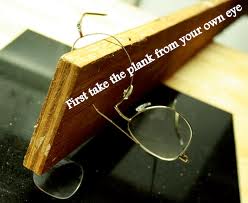
 “Do not judge, or you too will be judged…first take the plank out of your own eye, and then you will see clearly to remove the speck from your brother’s eye.”

_

In my mid-sixties I have entered a time in life when reminiscing becomes more poignant.  I can see far more clearly the carefree days of youth, when I threw myself into the maze of experience, confident that the future was now and all that mattered was the present. Decades of living and aging have tempered this rashness until now there is a sobriety and humility about life. 

The assertions that drove me to selfhood and independence also turned out to be a willfulness that took me beyond the restrictions and standards meant to keep me safe into places I should have avoided, and steered my life in ways both great and small onto the shoals of grief and heartache. And when I began to come to my senses, seeking a solid road of abiding values or an unbroken ascent to a promising future, I discovered that in a thousand ways the downward pull of the world was more than a match. It was then that life became a juggling act of living with the contaminations of compromise and the  tempering of disappointment . 

I would argue that in some measure this describes every human life. Although the details vary, the dynamics do not. Youthful idealism may have its brief moment but every person eventually must face the corrosive effects of life, the very real dimensions of loneliness, fear and failure, the destructive and deforming contagion of willfulness. 

A lot can be said about this but I want to make a singular point. I have been in the pastoral ministry long enough to have observed that far too many people in the church seem to have no capacity to recognize this struggle in the lives of others, nor do they honestly confront it in themselves. The church seems to often to be a place where it is permissible to come down on the defections of others, thanking God we are not like them, as if we are not bound in our own willfulness and pretensions.

Christian people are to take their cues from the one who went to the Cross, the one who said, “Do not judge, or you too will be judged…first take the plank out of your own eye, and then you will see clearly to remove the speck from your brother’s eye.”

The convoluted shamble of your life, however well you may be hiding it, has only one anecdote; the contagion of God’s love and mercy in Jesus. And for this anecdote you can offer nothing. It is God’s free and gracious gift to you. It is this love that restores us, not to idealism but to hope. For that hope cannot be compared to the frantic idealisms of the world. It is rooted in God’s promises and it will never disappoint.


“May the peace of God that passes all understanding keep your hearts and minds in Christ Jesus our Lord.”


_